
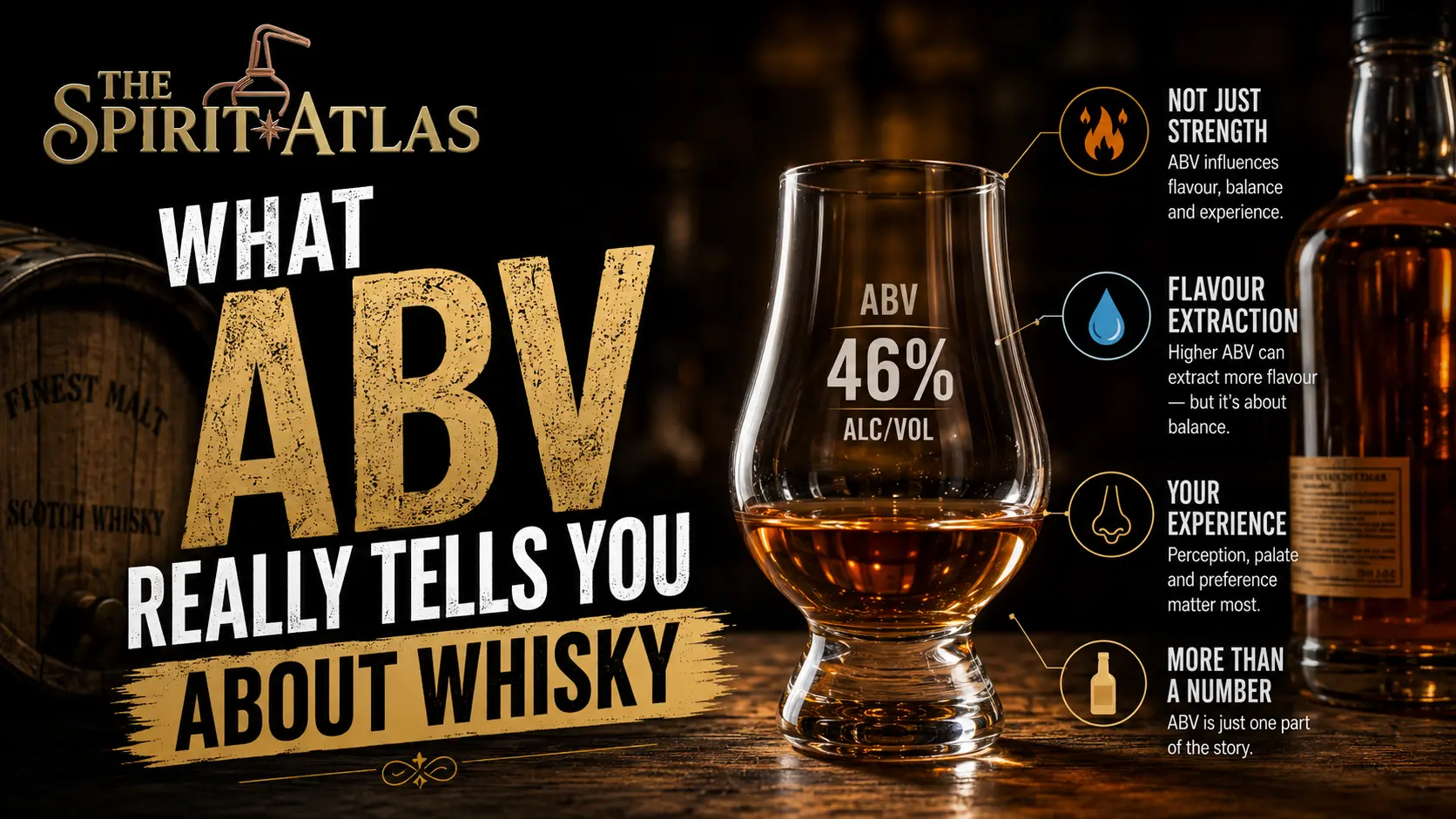
What ABV Really Means in Whisky
ABV stands for Alcohol By Volume. It tells you what percentage of the liquid in a bottle is pure ethanol. A whisky bottled at 46% ABV means 46 millilitres out of every 100 millilitres is alcohol, and the remaining 54 millilitres is water plus the flavour compounds that make whisky taste the way it does.
Most people read ABV as a measure of how strong a drink is. That is true in the most literal sense, but it misses most of what ABV actually communicates about a whisky. Alcohol concentration directly affects texture, the way aromas reach your nose, how sweet or dry the whisky feels on the palate, and whether certain flavour compounds are even detectable at a given strength. Understanding what ABV really tells you changes how you choose whisky, how you serve it, and how much you enjoy it.
Written by Shivam Sharma, founder and editor of The Spirit Atlas
The Legal Floor: Why 40% ABV Is the Minimum
In India, Scotland, the European Union, and most countries with formal spirits regulation, 40% ABV is the legal minimum for a product to be sold and labelled as whisky. Below 40%, the spirit must be labelled as something else, typically a spirit drink or a flavoured spirit. This minimum was not chosen arbitrarily.
Below 40% ABV, the balance between alcohol, water, and flavour compounds in whisky begins to shift in ways that most tasters describe as thin, watery, or lacking character. The alcohol acts as a carrier for the heavier aromatic molecules that came from the grain, fermentation, and the oak cask during maturation. Too little alcohol and those molecules do not stay suspended in the liquid well enough to deliver consistent flavour. The 40% floor is the threshold below which most whisky simply does not taste like whisky anymore.
In India specifically, almost all IMFL whisky is bottled at 42.8% ABV, which is the standard set by Indian state excise regulations. This applies to brands from Royal Stag at Rs 450 to premium IMFL expressions at Rs 2,000. The standardisation makes price comparison easier but also means you cannot use ABV as a quality differentiator within the IMFL category.
Why 46% Is a Magic Number in Whisky
If you spend any time around serious whisky drinkers or read bottle labels on premium Indian single malts and Scotch expressions, you will notice that 46% ABV appears very frequently. This is not coincidence. It reflects an important scientific and practical threshold in whisky production.
When whisky is chilled below around 15 degrees Celsius, or when water is added to reduce the ABV below approximately 43% to 46%, certain naturally occurring fatty acid esters in the spirit come out of solution. These compounds are not harmful, but they cause the whisky to turn cloudy or hazy. Distilleries that bottle at or below 43% ABV typically use a process called chill filtration to remove these compounds before bottling, which prevents the cloudiness but also strips out some of the texture and mouthfeel that makes premium whisky feel rich and satisfying.
At 46% ABV, the alcohol concentration is just high enough that these fatty acid esters stay dissolved in the liquid without refrigeration or filtration. This means a whisky bottled at 46% can be released as non-chill filtered and with natural colour, which preserves more of its original texture, depth, and the compounds that contribute to the long, complex finish that distinguishes a great whisky from a merely good one.
Indri Trini is bottled at 46% and non-chill filtered. So is Paul John Bold. Both decisions reflect the same understanding: at 46%, you get to keep more of what makes the whisky good. The difference in mouthfeel and finish between a 40% chill-filtered expression and a 46% non-chill-filtered one from the same distillery is noticeable, sometimes dramatically so.
How ABV Shapes Aroma: The Science Worth Knowing
Here is the part that surprises most whisky drinkers. ABV does not just determine how strong a whisky smells. It determines which specific aromatic compounds your nose can detect at all.
A compound called guaiacol is responsible for the smoky, peaty character in whiskies like Laphroaig 10 and Amrut Fusion. Research published in Scientific Reports showed that guaiacol preferentially concentrates at the surface of the liquid at higher alcohol concentrations, where it is harder for your nose to detect. When you add a few drops of water and reduce the ABV slightly, guaiacol is displaced from the surface into the vapour above the liquid, where your olfactory receptors can actually reach it. This is why adding water to a peated whisky often makes it smell more smoky, not less. The same principle applies to many other aromatic compounds that are suppressed at higher ABV levels.
This is not a quirk of one or two flavour compounds. It is a general principle of how aromatic molecules behave in ethanol-water solutions. The practical conclusion: adding a small amount of still water to whisky at 46% ABV or above is not dilution for the sake of reducing strength. It is a deliberate technique for making more of the whisky's aromatic complexity accessible to your nose. Master distillers do this routinely when assessing their own products.
The full guide on serving technique including how much water to add, when to use ice, and how temperature affects both aroma and flavour is in the how to drink whisky guide.
ABV and Texture: Why Higher Strength Feels Different
Alcohol has its own physical properties beyond the flavour compounds it carries. At higher concentrations, ethanol itself creates a sensation on the palate that is variously described as warming, burning, viscous, or oily depending on the concentration and the drinker's tolerance. This is what most people mean when they say a whisky "has a kick" or "goes down smooth."
Standard expressions at 40% to 43% ABV feel lighter and thinner on the palate. The alcohol warming is mild and does not linger. Premium expressions at 46% feel noticeably fuller and richer, with more body and a longer warmth in the finish. Cask strength expressions at 55% to 65% ABV can feel intensely warming, almost viscously thick, with the alcohol heat becoming a primary sensation rather than a background note.
Neither is objectively better. The 40% IMFL whisky in your everyday highball and the 58% cask strength Indian single malt in a nosing glass serve completely different purposes. Knowing what ABV does to texture helps you match the strength to the occasion and the serve rather than simply assuming higher is better.
What Is Cask Strength Whisky?
Cask strength whisky is bottled directly from the cask at whatever ABV the maturation process produced, without the addition of water to reduce the strength to a standard bottling level. When a distillery fills a cask with new make spirit, it enters at around 63% ABV. Over years in the barrel, some alcohol and water evaporate (the Angels' Share), and the spirit interacts with the wood. Depending on the climate, cask size, maturation length, and wood type, the final ABV when the cask is opened can be anywhere from around 52% to 65% or occasionally higher.
Cask strength expressions are valued by enthusiasts because they represent the whisky at its most concentrated and unmediated. The distillery has added nothing beyond what came from the still and the barrel. You taste exactly what the cask produced. The trade-off is intensity: at 60% ABV, the alcohol heat can obscure more delicate flavours until water is added, at which point cask strength whiskies often open up dramatically in ways that standard-strength expressions cannot.
Amrut Cask Strength and various limited Paul John expressions are examples of cask strength Indian single malts. If you try one, always start with a small pour at full strength, then add water drop by drop until the whisky reveals itself. Rushing to add too much water at once loses control of the process.
ABV by Whisky Category: A Practical Reference
| Category | Typical ABV | Examples Available in India | Key Characteristics |
|---|---|---|---|
| Economy IMFL | 42.8% | Royal Stag, McDowell's No.1 | Standard excise strength, light texture |
| Standard blended Scotch | 40% to 43% | Chivas Regal 12, Ballantine's Finest | Smooth, chill filtered, lighter body |
| Premium single malt | 43% to 46% | Glenfiddich 12, Indri Trini | Non-chill filtered possible, richer body |
| Indian single malt | 42.8% to 50% | Amrut Fusion (50%), Paul John range | Tropical maturation produces intense flavour |
| High-proof bourbon | 50% to 55% | Wild Turkey 101 (50.5%) | Spicy, intense, stands up to cocktail mixing |
| Cask strength | 52% to 65%+ | Amrut Cask Strength, Paul John CS | Undiluted, add water to taste |
ABV and Calories: The Direct Connection
One practical consequence of ABV that is worth understanding is its direct relationship to calorie content. Ethanol contains approximately 7 calories per gram, which makes it almost as calorically dense as fat. A standard 30ml peg of IMFL whisky at 42.8% ABV contains roughly 70 to 75 calories from the alcohol alone. Whisky contains zero sugar and zero fat, so the calorie count increases purely as ABV increases.
A 30ml pour of Amrut Fusion at 50% ABV contains around 85 to 90 calories. A 30ml pour of cask strength at 60% ABV contains around 100 to 110 calories. These differences matter for those monitoring calorie intake. The full breakdown across every pour size and ABV level is in the whisky calories guide.
How to Use ABV When Choosing a Whisky
Rather than treating ABV as simply a strength rating, use it as one of several signals about what to expect from a bottle. A whisky bottled at 40% is almost certainly chill filtered and may have slightly less texture than a non-chill filtered alternative. A whisky at 46% signals that the producer made a specific decision to preserve natural texture and colour. A cask strength expression signals intensity, complexity, and the expectation that you will dilute to taste.
For everyday mixing in cocktails and highballs, 40% to 43% is practical: the flavour holds up to mixers and the lower ABV means you can pour generously without the drink becoming unpleasantly strong. For neat sipping or simple water-addition serves, 46% tends to be the sweet spot where richness and drinkability are best balanced. For exploring a whisky's full depth, cask strength is the most revealing format, but only if you are prepared to add water thoughtfully.
The whisky alcohol percentage guide covers the full technical picture including ABV vs proof, how Indian excise standards compare to international norms, and why the 42.8% standard in India matters for the domestic market.
Frequently Asked Questions: What ABV Really Tells You
What does ABV mean on a whisky bottle?
ABV stands for Alcohol By Volume. It tells you what percentage of the liquid in the bottle is pure ethanol. A 46% ABV whisky means 46% of the liquid is alcohol and 54% is water and flavour compounds. It is the standard measurement for alcohol content used on spirits bottles globally, including all whisky sold in India.
Why is 46% ABV significant in whisky?
At 46% ABV, the alcohol concentration is high enough to keep naturally occurring fatty acid esters dissolved in the liquid without refrigeration or chill filtration. This means the distillery can bottle the whisky without filtering out the compounds that contribute to texture and mouthfeel. Most premium single malts bottled at 46% are non-chill filtered, which is why they feel richer and have a longer finish than filtered expressions at 40%.
Does higher ABV mean better whisky?
No. ABV affects the style and character of a whisky, not its quality. A well-made 40% blended Scotch can be more enjoyable than a poorly made 60% cask strength expression. Higher ABV means more alcohol heat, more intense concentration, and in some cases more complexity, but quality depends on the grain, fermentation, distillation, and maturation, not the bottling strength.
What is cask strength whisky?
Cask strength whisky is bottled at whatever ABV the maturation process produced, without adding water to reduce it to a standard strength. This typically results in ABV between 52% and 65% depending on the cask, climate, and maturation period. Cask strength expressions are valued for their intensity and concentration, though they almost always benefit from adding a small amount of water before drinking.
Why is Indian whisky bottled at 42.8% ABV?
42.8% ABV is the standard excise strength set by most Indian state governments for IMFL whisky. This standardisation simplifies taxation and retail pricing across the country. It applies to economy IMFL brands like McDowell's No.1 and Royal Stag as well as many mid-range expressions. Premium Indian single malts and some imported expressions are bottled at higher strengths at the distillery's discretion.
Does adding water to whisky make it worse?
No. Adding a few drops of still water to whisky, particularly at 46% ABV or above, often makes it better by releasing aromatic compounds that are suppressed at higher alcohol concentrations. This is documented science, not personal preference. The compound guaiacol, which contributes to smoky character in peated whisky, is more detectable after water addition. Master distillers add water when assessing their own products for exactly this reason.
What ABV is best for whisky cocktails?
For cocktails, 40% to 43% ABV expressions are usually the most practical because they provide enough alcohol backbone without overpowering the other ingredients, and they are generally less expensive than higher-strength expressions. For cocktails that need the whisky to stand out against strong mixers (like an Old Fashioned or a robust whisky sour), going to 46% or higher ABV gives the spirit more presence in the finished drink. The best whisky for cocktails guide covers which specific bottles work best for different cocktail formats.