What is Single Malt Whisky?
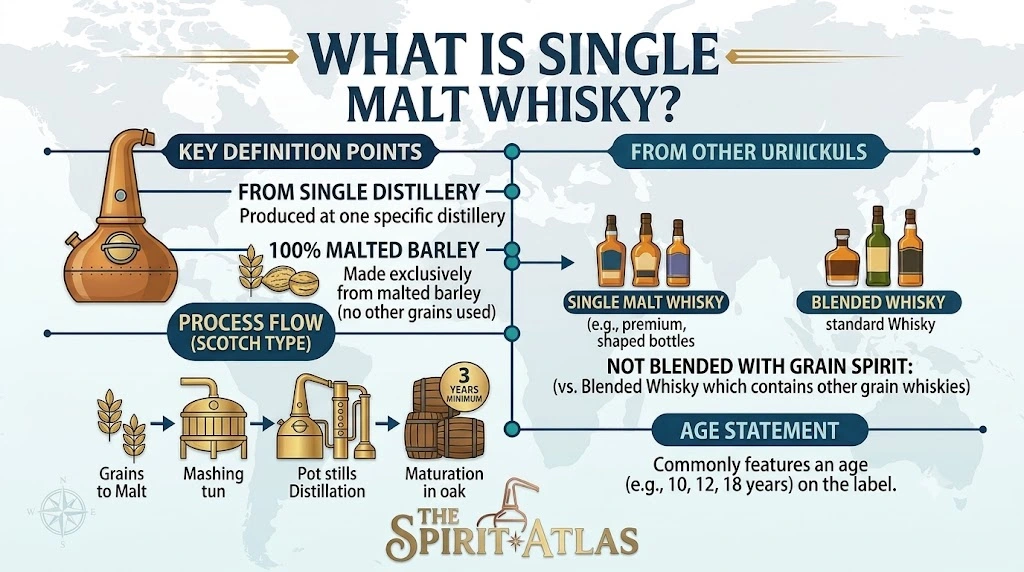
Single malt whisky is whisky made from 100% malted barley and produced at a single distillery. That is the entire definition. Two words, two rules. "Malt" means only malted barley was used, no other grains. "Single" means everything came from one distillery, nowhere else.
This definition trips people up because the natural assumption is that "single" means one barrel or one batch. It does not. A single malt can be drawn from dozens of different casks, all from the same distillery, blended together by the master distiller before bottling. What it cannot do is pull whisky from a second distillery. The moment that happens, it becomes a blended malt, not a single malt.
Single malt whisky is found across the world today. Scotland is the most famous producer, but Japan, Ireland, India, Taiwan, and the United States all make single malts that have won major international awards. If you want to explore Indian single malt specifically, the Indian single malt category on The Spirit Atlas covers every major expression with tasting notes and current India prices.
Written by Shivam Sharma, founder and editor of The Spirit Atlas
How Single Malt Whisky is Made
The process is the same whether you are making single malt in Scotland or in Rajasthan. It starts with barley, goes through malting, mashing, fermentation, distillation, maturation, and then bottling. Each step matters to the final character of the whisky. The full guide on how whisky is made covers every stage in detail. Here is the short version:
Malting - Barley is soaked in water and allowed to partially germinate, activating enzymes that will later convert starch into fermentable sugar. The germination is then stopped by heating the barley in a kiln. If peat is used as fuel during kilning, the barley absorbs smoky compounds called phenols, which become the signature of peated whisky.
Mashing - The malted barley is ground into grist and mixed with hot water in a mash tun. This extracts the fermentable sugars into a sweet liquid called wort.
Fermentation - Yeast is added to the wort and fermentation runs for 48 to 96 hours, producing a beer-like liquid called wash at around 8% ABV. The length and conditions of fermentation develop much of the fruity character in the final whisky.
Distillation - Single malt must be distilled in copper pot stills. Most distilleries distill twice. The shape and size of the still directly affects the character of the spirit. Taller stills produce lighter whisky. Shorter stills produce richer, heavier spirit.
Maturation - The new make spirit goes into oak casks and matures for years. Ex-bourbon casks add vanilla and honey. Ex-sherry casks add dried fruit and spice. The legal minimum for Scotch is three years.
Single Malt vs Blended Whisky: The Key Difference
Single malt comes from one distillery using only malted barley. Blended whisky combines malt and grain whiskies from multiple distilleries. For the full picture on what blended whisky is and how it is made, the blended whisky guide covers everything.
Blended whisky is not inferior to single malt. Johnnie Walker Black, Chivas Regal 18, and Ballantine's are all blended whiskies and they are genuinely excellent drinks. The practical difference for drinkers: single malt tends to be more expensive and offers a more distinct, identifiable flavour tied to one specific production source. Blended whisky is designed for consistency and broad palatability.
What Does Single Malt Taste Like?
There is no single answer because single malts vary enormously based on region, distillery style, cask type, and age. Speyside single malts tend to be fruity, honeyed, and gentle. Glenfiddich 12 is a classic example of this style. Islay malts are famous for peat smoke, iodine, and sea salt.
Indian single malts have their own character shaped by tropical climate maturation. What takes 12 years in Speyside can happen in 5 to 7 years in India because heat accelerates the spirit's interaction with the wood. This produces richer, more intensely tropical fruit-forward single malts with mango, banana, and dried stone fruit notes. Most Indian single malts are classified as IMFL within India's regulatory system, which is important to understand for pricing and availability.
Single Malt Whisky Alcohol Percentage
Most single malt whisky is bottled between 40% and 46% ABV. Many premium expressions are bottled at exactly 46% because this enables natural colour retention and non-chill filtration, which preserves more of the whisky's natural texture and flavour. Cask strength single malts go higher, sometimes to 60% ABV or more. For a full breakdown of what ABV means and how it affects taste, the whisky alcohol percentage guide covers this in detail.
Best Indian Single Malts to Try in 2026
| Brand | Distillery | Style | Approx. India Price (750ml) |
|---|---|---|---|
| Indri Trini | Piccadily, Haryana | Triple cask, fruity | Rs 3,500 |
| Paul John Brilliance | John Distilleries, Goa | Light, tropical | Rs 2,800 |
| Amrut Fusion | Amrut, Bangalore | Rich, complex | Rs 3,200 |
| Rampur Select | Radico Khaitan, UP | Smooth, balanced | Rs 2,500 |
| Crazy Cock Madhuca III | South Seas Distilleries | Mahua cask, smoky | Rs 4,200 |
All prices are approximate and vary by state. See the Indian single malt price guide for current state-wise rates.
Frequently Asked Questions About Single Malt Whisky
What does single malt whisky mean?
Single malt whisky means whisky made from 100% malted barley and produced at a single distillery. The word "single" refers to the distillery, not the cask or barrel. Multiple casks from the same distillery can be combined to make a single malt expression.
Is single malt better than blended whisky?
Not automatically. Single malt offers a more distinct distillery character and is often more complex, but quality depends on production and maturation, not the category label. Excellent blended whiskies exist at every price point, and a mediocre single malt can easily be outperformed by a well-crafted blend.
What is the difference between single malt and double malt whisky?
There is no official category called double malt in the whisky world. Single malt is a defined, legal classification. Double malt is sometimes used informally to describe whisky matured in two types of casks, but it has no standard meaning and is not a regulated term.
How long does single malt have to be aged?
For Scotch single malt, the legal minimum is three years in oak casks. For Indian single malts, there is no mandated minimum age under current Indian regulations, though most distilleries mature their whisky for 5 to 8 years given the faster tropical maturation environment.
What is an Indian single malt?
An Indian single malt is whisky made from 100% malted barley at a single distillery in India. Brands like Indri, Paul John, Amrut, Rampur, and Crazy Cock fall into this category. India's tropical climate accelerates maturation, giving these whiskies a richer, more intense tropical fruit character compared to their Scottish counterparts.
Can single malt be made from grains other than barley?
Under traditional Scotch whisky regulations, no. Single malt Scotch must use 100% malted barley. American single malt regulations, finalised in 2025, also require 100% malted barley. The global understanding of single malt is firmly tied to malted barley regardless of producing country.
What is the best single malt for beginners in India?
For beginners in India, Paul John Brilliance is an excellent starting point. It is lighter in style, non-peated, and shows off the tropical fruit character of Indian single malt without being overwhelming. Indri Trini is another great option at a slightly higher price. Both are far more approachable than heavily peated expressions and give a clear picture of what Indian single malt distilling can produce.