The Basic Idea Behind Making Whisky
Every bottle of whisky in the world, whether it is a Scotch single malt, an Indian craft expression, a Kentucky bourbon, or a Japanese blend, started its life as grain. Usually barley. Sometimes corn, wheat, or rye. The distiller's job is to extract the sugar from that grain, let yeast turn it into alcohol, concentrate that alcohol through distillation, and then wait while oak casks transform the raw spirit into something worth drinking.
The steps are the same everywhere. What changes is the grain, the still design, the water, the cask, the climate, and the amount of patience the distiller is willing to exercise. Those variables are what make an Indri single malt taste different from a Glenfiddich 12, even though both followed the same fundamental process.
Written by Shivam Sharma, founder and editor of The Spirit Atlas
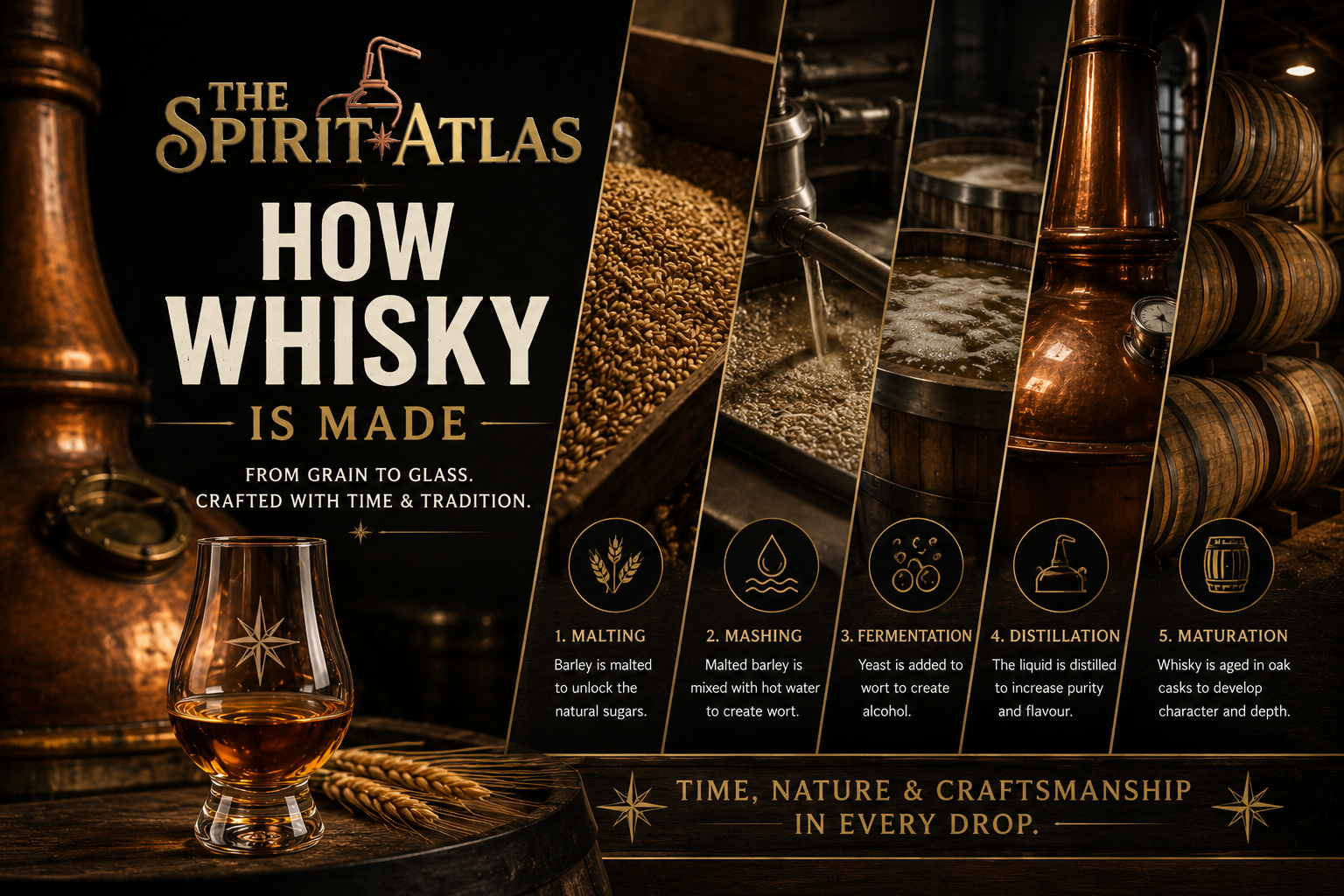
Step 1: Malting
Malting only applies to malt whisky. If you are making grain whisky using wheat or corn for a blended whisky, you skip most of this step. For single malt whisky, malting is where everything begins.
Barley grains are soaked in water for two to three days, waking them up and triggering germination. This activates enzymes inside the grain that will later convert the starch into fermentable sugar. The germination is stopped before the barley sprout can grow too far by heating the grain in a kiln.
Here is the crucial decision: what fuel goes into the kiln. Hot air produces unpeated, clean barley. Burning peat carries phenolic compounds that stick to the barley and infuse into the final spirit, producing the smoky character that defines peated whisky. The amount of peat smoke the barley absorbs is measured in PPM (phenol parts per million) and determines how smoky the final whisky will be.
Step 2: Mashing
After drying, the malted barley is ground into a coarse flour called grist. This grist goes into a large vessel called a mash tun, where it meets hot water at precisely controlled temperatures. The hot water activates the enzymes to convert starch into fermentable sugars and dissolves those sugars into the liquid.
The result is a sweet, cloudy liquid called wort. The spent grain solids, called draff, are filtered out and often sold as cattle feed. The wort moves on to fermentation.
Step 3: Fermentation
The wort is cooled and pumped into large vessels called washbacks, which can be wood or stainless steel. Yeast is added and fermentation begins. The liquid bubbles and froths as yeast feeds on the sugars and converts them into alcohol and carbon dioxide.
Fermentation takes 48 to 96 hours. At the end, the liquid, now called wash, contains around 7% to 10% ABV. It resembles a strong, slightly sour beer. Not pleasant to drink, but ready for the next step.
Step 4: Distillation
Distillation is what separates whisky from beer. Alcohol boils at a lower temperature than water (around 78 degrees Celsius versus 100 degrees). When the wash is heated in a copper pot still, the alcohol vapourises first, rises up through the still, and condenses back into liquid in a cooling coil. This concentrates the alcohol and removes many heavier compounds.
For single malt whisky, this happens at least twice. The first distillation produces low wines at around 25% ABV. The second distillation requires the distiller to separate the run into three parts: foreshots (toxic, discarded), the heart cut (kept for maturation), and feints (weak and unpleasant, discarded). Only the heart cut becomes whisky. Getting those cut points right is one of the most important skills in whisky making.
Copper is not incidental. It actively reacts with the spirit, removing sulphur compounds. The shape and height of the still also matters enormously. Tall stills produce lighter, more delicate spirits. Short, fat stills produce heavier, richer spirit. This is why every distillery's whisky tastes different even when barley, water, and yeast are similar.
Step 5: Maturation
When the new make spirit comes off the still, it is colourless. It has character but is raw and legally not yet whisky. For Scotch, it must spend at least three years in oak casks before it can be called whisky.
The new make spirit, reduced to around 63% ABV with water, goes into oak casks and is sealed in dark warehouses. Three key things happen during maturation: the wood absorbs some harsher compounds, the spirit extracts flavour compounds from the wood (vanilla and caramel from American oak, dried fruit and spice from European oak), and around 2% of the liquid evaporates each year through the porous wood. This evaporation is called the Angels' Share. A whisky matured for 18 years has lost roughly a third of its original volume before it ever reaches a bottle.
The choice of cask matters enormously. Ex-bourbon barrels, ex-sherry casks, wine casks, and even more exotic choices like Mahua casks, used by the Crazy Cock distillery for their IWSC 2026 gold medal expression, create dramatically different flavour outcomes.
In India, the tropical climate means maturation is much faster than in Scotland. What takes 12 years in Speyside can happen in 5 to 7 years in India, giving Indian single malts a richer, more intensely tropical character. Once bottled, whisky stops ageing entirely. The guide on how to store whisky covers what happens after that.
Step 6: Blending and Bottling
After maturation, casks are selected and combined to build the final expression. The whisky is usually diluted with water to bottling strength (40% to 46% ABV), filtered, labelled, and sealed. Understanding whisky alcohol percentage helps you make sense of what those numbers on the label actually mean for the drinking experience.
How Indian IMFL Whisky is Made Differently
Most IMFL whisky consumed in India follows a different path from Scottish single malt. The most common economy and mid-range Indian whisky starts not with malted barley but with neutral spirit distilled from molasses, a byproduct of the sugarcane industry. This neutral spirit comes off the column still at 96% ABV and is then reduced, flavoured, coloured, and blended. A proportion of actual grain or malt whisky is added to build character. This is a completely legitimate production method that produces consistent, affordable spirits. It simply produces a different kind of drink from pot still single malt, which is why the two categories taste so different side by side.
| Whisky Type | Base Ingredient | Still Type | Min. Maturation |
|---|---|---|---|
| Scotch Single Malt | 100% malted barley | Copper pot still | 3 years in Scotland |
| Indian Single Malt | 100% malted barley | Copper pot still | No legal minimum |
| IMFL Blended Whisky | Molasses neutral spirit + malt | Column still + pot | Varies by brand |
| Bourbon (USA) | 51%+ corn | Column still | 2 years in new oak |
Frequently Asked Questions About How Whisky is Made
What are the main ingredients in whisky?
Whisky is made from three core ingredients: grain (usually malted barley for single malt, or a combination of grains for blended and grain whisky), water, and yeast. The grain provides the sugar, the water extracts it, and the yeast converts the sugar into alcohol. Oak casks during maturation provide the fourth key element: flavour, colour, and complexity from the wood.
How long does it take to make whisky?
From grain to bottle takes a minimum of three years for Scotch whisky. Most commercial expressions take 8 to 18 years. Indian single malts typically mature in 5 to 8 years due to the tropical climate. The distillation and fermentation steps themselves take only days. Maturation is what takes the time.
What is the angels' share in whisky production?
The angels' share is the volume of whisky that evaporates through the porous oak cask during maturation, typically around 2% of the liquid per year. Over a 12-year maturation period, a cask can lose 20% to 25% of its original volume. This is why older whiskies are scarcer and more expensive.
What is the difference between pot stills and column stills?
Pot stills are traditional copper vessels used in batch distillation, mainly for single malt whisky. They produce richer, more flavourful spirits but must be stopped and restarted for each batch. Column stills run continuously, producing spirit much more efficiently at higher alcohol strengths. They are used for grain whisky production and most IMFL economy whisky production in India.
Why is whisky aged in oak specifically?
Oak has the right combination of properties for whisky maturation. It is watertight enough to prevent too much evaporation but porous enough to allow some air exchange, which softens the spirit over time. Oak also contains natural compounds including tannins, lignins, and lactones that dissolve into the spirit and contribute vanilla, caramel, spice, and fruit flavours. No other commercially available wood achieves this combination as effectively.
Does whisky keep ageing once it's in the bottle?
No. Whisky stops ageing once it is bottled. The ageing process requires the interaction between spirit and wood, which only happens in the cask. An 18-year-old whisky bottled today will still be an 18-year-old whisky in 30 years, as long as the bottle remains sealed. Once opened, the whisky will slowly change due to oxidation, but this is not maturation.