
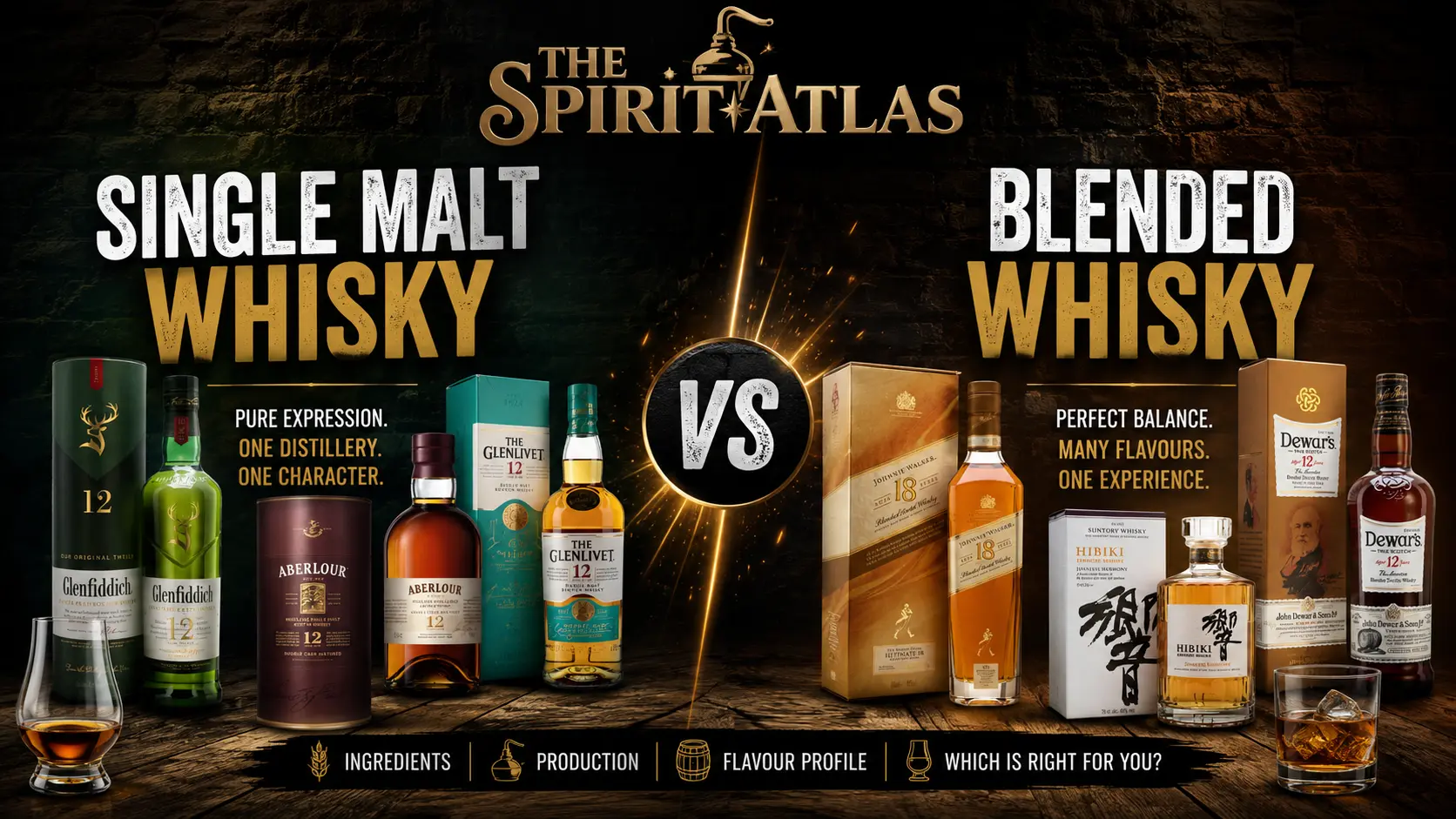
Single Malt vs Blended Whisky: What Actually Separates Them
Single malt and blended whisky are two different production approaches, not two rungs on a quality ladder. The idea that single malt is inherently superior to blended whisky is one of the most pervasive myths in the drinks world, and it came primarily from clever marketing by Scotch single malt producers in the 1980s and 1990s rather than from any objective assessment of what is in the glass.
Understanding what these two categories actually mean, how they are made differently, and where each genuinely has an advantage over the other is more useful than the tribal loyalty most whisky conversations produce. Both categories have produced some of the finest spirits humans have ever made. Both have also produced plenty of forgettable bottles.
Written by Shivam Sharma, founder and editor of The Spirit Atlas
What is Single Malt Whisky?
Single malt whisky is whisky made from 100% malted barley and produced at a single distillery. Two rules, two words. "Single" means one distillery. "Malt" means only malted barley was used as the grain. Both conditions must be met simultaneously. A whisky made from 100% malted barley at two different distilleries and combined is a blended malt, not a single malt. A whisky made at one distillery from a mix of barley and wheat is a grain whisky, not a malt.
Within those rules, a single malt expression can draw from many different casks filled over many different years at that one distillery. Indri Trini, for example, is a single malt that combines whisky from three different cask types: ex-bourbon, French wine casks, and PX sherry. The whisky from each cask type was made at Piccadily Distilleries in Haryana. The combining of those casks does not make it a blended whisky because all the liquid came from one distillery.
Single malt is found across the world. Scotland, India, Ireland, Japan, Taiwan, and the United States all produce single malts. The style varies dramatically by region and distillery. A Glenfiddich 12 from Speyside and a Amrut Fusion from Bangalore are both single malts made under the same production rules, yet they taste completely different because the climate, water, barley, still shape, and cask regime at each distillery produce entirely distinct spirits. This is the genuine virtue of single malt: it is an expression of one place.
What is Blended Whisky?
Blended whisky combines malt whisky and grain whisky from multiple distilleries. In the most common format, blended Scotch whisky, a master blender combines single malt Scotch from various distilleries (which provides the flavour and character) with grain Scotch whisky from column still distilleries (which provides a lighter, more neutral base and allows the blend to be produced at scale). The ratio is typically around 30% to 40% malt and 60% to 70% grain, though premium blends use higher malt proportions.
Grain whisky is not inferior whisky. It is different whisky produced by a different method (continuous column still distillation versus pot still batch distillation) from different grains (wheat and corn rather than barley). Grain whisky is lighter, more neutral, and higher strength off the still. In a blend, it provides the canvas. The single malts provide the colours.
The master blender's task is remarkable: to combine whisky from dozens of different distilleries, each with its own character, in proportions that create a consistent and specific flavour profile, year after year, across millions of bottles. When Chivas Regal 18 tastes the same whether you buy it in Delhi or Tokyo, that is not an accident. It is the result of a master blender working with warehouses containing thousands of casks from multiple distilleries to maintain a precise house style across time.
In India: What Counts as Blended?
In India, the IMFL whisky category covers what are technically blended spirits, though the production method differs from Scotch blending. Most economy and mid-range IMFL blends use neutral spirit distilled from molasses as the base, blended with a small proportion of actual grain or malt whisky and sometimes imported Scotch malt in bulk. This produces a consistent, affordable product designed for mixing rather than contemplative sipping.
Premium IMFL blends like Blenders Pride Reserve Collection use a higher proportion of genuine imported Scotch malt whisky from Chivas Brothers matured through the Solera process, which produces a noticeably more developed flavour than economy expressions. The gap between Rs 450 Royal Stag and Rs 1,500 Blenders Pride Reserve is not just price: it reflects genuinely different ingredients and production.
The Real Quality Comparison
Here is where the single malt versus blended argument becomes genuinely interesting rather than tribal. In blind tastings where drinkers cannot see the label or know the price, the results consistently show that people cannot reliably identify single malts versus blended whiskies, and that the preference for single malt largely disappears without label information.
A well-crafted blended Scotch at Rs 5,000 frequently outperforms a mediocre single malt at Rs 8,000 in the glass. The blending process, when executed at the highest level, can create flavour complexity and harmony that no single distillery could achieve by itself. Chivas Regal 18 draws from dozens of distilleries across Scotland to produce a whisky of remarkable depth and integration. The sum is genuinely greater than any individual part would be alone.
Conversely, the best single malts offer something that blending cannot: a completely specific, identifiable expression of one place and one production tradition. When you taste Laphroaig 10, you are tasting Islay peat, the specific cut of the Laphroaig stills, the maturation conditions in Islay's maritime warehouse, and nothing else. No blend can give you that specificity. Whether that specificity is more valuable than the harmony a great blend achieves is a preference question, not a quality question.
Single Malt vs Blended in India Specifically
In the Indian market, the comparison takes on a particular dimension because of import duties. Imported blended Scotch like Chivas 12 attracts roughly 150% customs duty, making it significantly more expensive than comparable quality Indian expressions. An Indian single malt at Rs 3,500 is competing against imported blended Scotch at Rs 2,500 to Rs 3,000, despite the Indian single malt being a fundamentally more complex and labour-intensive product.
This creates an unusual value equation. Indri Trini at Rs 3,500 to Rs 4,800 depending on state won Gold at the World Whiskies Awards 2026. Amrut Fusion at Rs 3,200 to Rs 4,000 rates 9.0/10 at The Spirit Atlas. Paul John Bold at Rs 3,000 to Rs 4,000 rates 8.7/10. These are single malts competing directly on quality with imported blended Scotch at higher prices. The most discussed whisky myth in India today is that imported blended Scotch is automatically more prestigious than Indian single malt. The award results of 2026 make that argument increasingly difficult to sustain. The full picture of India's best single malts is in the best Indian single malts 2026 guide.
Types of Blended Whisky You Should Know
Blended whisky is not one monolithic category. Three distinct sub-categories exist and they are not equal in character:
Blended Scotch Whisky: Combines single malt and grain whisky from multiple Scottish distilleries. This is the most common format globally. Johnnie Walker Black, Chivas Regal 12, Ballantine's Finest are all blended Scotch.
Blended Malt Whisky: Combines single malt whiskies from two or more distilleries, with no grain whisky. Because there is no grain whisky to lighten the character, blended malts tend to be richer and more complex than standard blended Scotch. Monkey Shoulder is the most recognisable commercial example. Rarer and not widely available in India.
Blended Grain Whisky: Combines grain whiskies from multiple distilleries. Lightest and most neutral of the three. Rarely encountered as a standalone product in India.
How to Choose Between Single Malt and Blended
The honest answer is: drink both and decide what you prefer for what occasion, rather than committing tribal loyalty to one category. But if you need a practical framework:
Choose single malt when you want to explore what a specific distillery, region, or production tradition tastes like. Choose single malt when you want the most direct expression of the grain, cask, and climate. Choose single malt when you are drinking neat or with minimal dilution and want the flavour to be the point.
Choose blended whisky when you want consistency and reliability across multiple bottles and years. Choose blended when you are making cocktails where the nuance of single malt would be lost. Choose blended when the occasion calls for something universally accessible and approachable. Choose blended when you find a specific blend that consistently gives you more pleasure than any single malt at the same price.
The best whisky for beginners guide covers where to start when you are new to the single malt versus blended question. The best Scotch whisky India guide ranks both blended and single malt Scotch available in India with current prices.
| Factor | Single Malt | Blended Whisky |
|---|---|---|
| Grain used | 100% malted barley only | Malt + grain (wheat, corn, rye) |
| Distilleries | One distillery only | Multiple distilleries |
| Flavour character | Specific, identifiable, place-driven | Consistent, harmonious, balanced |
| Price in India | Rs 1,800 to Rs 10,000+ | Rs 1,200 to Rs 7,000 |
| Best for | Neat sipping, exploration | Cocktails, highballs, gifting |
| Objectively better? | No. Quality depends on the bottle, not the category. | |
Frequently Asked Questions: Single Malt vs Blended
What is the main difference between single malt and blended whisky?
Single malt whisky is made from 100% malted barley at a single distillery. Blended whisky combines malt whisky and grain whisky from multiple distilleries. Single malt offers a specific, identifiable flavour tied to one place and production method. Blended whisky is designed for consistency and broader palatability. Neither is automatically better than the other.
Is single malt whisky better than blended?
No. The idea that single malt is superior to blended whisky was largely a marketing construct from the 1980s. In blind tastings, people cannot reliably identify or consistently prefer single malts over well-made blends. A great blended Scotch like Chivas Regal 18 at Rs 5,500 often outperforms mediocre single malts at higher prices. Quality depends on production, ingredients, and maturation, not the category label.
Which is better for cocktails: single malt or blended?
Blended whisky is generally more suitable for cocktails because its consistent, balanced character integrates cleanly with mixers and its lower price means you can use it generously without wincing. The nuance and complexity of a premium single malt is largely lost in most cocktail formats. The best whisky for cocktails guide identifies the specific blended and bourbon expressions that work best in different cocktail types.
What is blended malt whisky?
Blended malt whisky combines single malt whiskies from two or more distilleries, with no grain whisky in the mix. Because it uses only malt whisky, it tends to be richer and more complex than standard blended Scotch, which includes grain whisky as the majority component. Monkey Shoulder is the most widely known commercial example. It sits in a quality tier between standard blended Scotch and the most premium single malts.
Is Chivas Regal a single malt or blended?
Chivas Regal is a blended Scotch whisky. Both the 12 and 18 Year expressions combine single malt Scotch whiskies from various Scottish distilleries with grain Scotch whisky. The blending is done by Chivas Brothers, part of Pernod Ricard. Despite being blended rather than single malt, Chivas Regal 18 is rated 8.0/10 and is the most recommended premium blended Scotch available in India. See Chivas Regal 18 at The Spirit Atlas for current India pricing.
Can Indian single malt compete with Scotch blends?
Yes, and the award results of 2026 demonstrate this clearly. Indri Trini and Amrut Fusion both win gold medals at international competitions where Scottish blended and single malt expressions also compete. At the price points available in India, Indian single malts often offer better value than imported blended Scotch because they avoid customs duties. The comparison is covered directly in the best Indian single malts 2026 guide.