
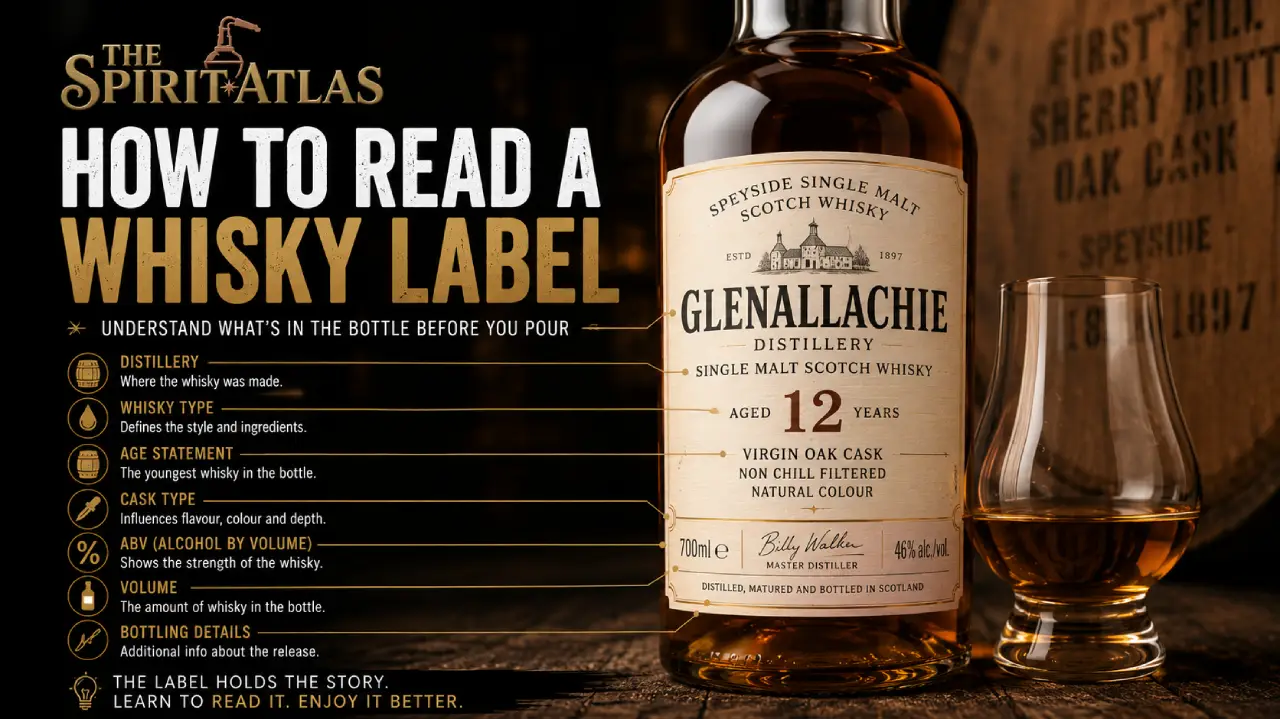
How to Read a Whisky Label
A whisky label is a compressed information document. In a few square centimetres it communicates the type of spirit, its origin, its age if stated, its strength, the production method, and sometimes the specific cask or maturation regime. Most of this information is legally mandated and standardised. Some of it is voluntary and marketing-driven. Knowing the difference changes how you interpret what you are being told and what you are being sold.
This guide covers every significant term, number, and phrase you will encounter on whisky labels in India, whether the bottle is a domestic IMFL brand, an Indian single malt, or an imported Scotch whisky.
Written by Shivam Sharma, founder and editor of The Spirit Atlas
Brand Name vs Distillery Name
The most prominent text on a whisky label is usually the brand name. This is often but not always the same as the distillery name. For large Indian single malt brands, the connection is straightforward: Indri is made at Piccadily Distilleries, Paul John is made at John Distilleries, Amrut is made at Amrut Distilleries. Brand and distillery align.
For Scotch whisky, particularly blended expressions, the brand name often has no direct relationship to any single distillery. Chivas Regal is a brand created by Chivas Brothers that draws whisky from multiple distilleries. Johnnie Walker is a brand owned by Diageo that does the same. The brand name on a blended Scotch tells you about the blending house and their house style, not about any specific distillery.
For Indian IMFL blends, the brand name (Royal Stag, Imperial Blue) and the producer (Pernod Ricard India, Seagram India) are separate. The production may happen at multiple bottling plants across India depending on state distribution arrangements. This is why IMFL prices vary by state: the product may be produced locally in each state to avoid inter-state transport taxes, and local excise duties apply at the point of production.
The Age Statement: What It Means and What It Does Not
An age statement on a whisky bottle is one of the most commonly misread pieces of information. The number on the label, whether it says 12 Year Old, 18 Year Old, or any other figure, refers to the youngest whisky in the bottle, not the average age or the oldest cask used.
For a blended whisky, this is particularly significant. A bottle of Chivas Regal 18 guarantees that every component whisky in the blend has been matured for at least 18 years. Some of those components may be 20, 22, or 25 years old. The 18 on the label is the floor, not the average. A bottle of Glenfiddich 12 guarantees a minimum of 12 years maturation for every cask that contributed to that bottle.
For single malt whisky, the age statement refers to the youngest cask used in that bottling run. Since the master distiller or blender combines multiple casks to achieve a consistent profile, the age statement tells you the minimum maturation any of those casks experienced.
What the age statement does not tell you is whether the whisky is good. A 12-year-old whisky from an excellent distillery using quality casks will outperform a 25-year-old whisky from a mediocre production process in almost every blind tasting. Age is a production cost indicator more than a quality guarantee. This is one of the key points in the whisky myths guide.
NAS: No Age Statement
NAS stands for No Age Statement. It means the producer has chosen not to declare the age of the whisky, which they are legally permitted to do in most jurisdictions including India and Scotland. This declaration of non-declaration appears on the label either explicitly as "NAS" or simply through the absence of any age information.
NAS whisky carries a stigma in some enthusiast circles, typically from drinkers who assume it means young or inferior. This is often wrong. Many NAS whiskies are excellent, and many are made that way for legitimate creative rather than cost-cutting reasons.
The most straightforward reason for NAS in Indian single malt is that age is not a reliable indicator of maturity in India's tropical climate. Indri Trini carries no age statement because the maturation in Haryana's extreme heat means the whisky is ready based on what it tastes like, not how long a calendar says it has been in a barrel. Declaring a specific age could mislead consumers into comparing it against Scotch age equivalents, when the comparison is not meaningful due to climate differences explained in detail in the angel's share guide.
For blended Scotch, NAS expressions from reputable blenders may use older whiskies than their age-stated counterparts but choose not to declare the age because the blend changes composition depending on what casks are available in a given year. NAS can mean "we have not committed to a specific minimum age" as much as it means "this is young whisky." Context matters.
ABV: The Number That Does More Than Measure Strength
ABV (Alcohol By Volume) on a whisky label tells you the strength of the spirit, but as covered in the ABV guide, it also communicates significantly more about the whisky's character. A quick decoder:
40% to 43% ABV: Almost certainly chill filtered to prevent cloudiness at low temperatures. Lighter body and texture. Standard for most mass-market expressions and economy IMFL.
46% ABV: Almost certainly non-chill filtered and with natural colour. Richer texture and mouthfeel. The producer made a deliberate decision to preserve the whisky's natural character at the cost of potential cloudiness when chilled. Indri Trini is 46%, a decision that signals quality intent.
50% and above: Either a higher-strength bottling decision for intensity, or approaching cask strength territory. Amrut Fusion at 50% ABV is the most widely available Indian single malt at this strength. Always worth adding a few drops of water before nosing.
Cask Strength (52% to 65%+): Bottled at whatever ABV the cask produced without water addition. The most intense and concentrated format. Water addition is essentially mandatory for comfortable drinking.
Non-Chill Filtered: What It Means and Why It Matters
Chill filtration is a process where whisky is chilled to around 0 degrees Celsius before bottling, causing certain fatty acid esters and other compounds to come out of solution and be filtered away. The reason distilleries do this is cosmetic: it prevents the whisky from going cloudy or hazy when chilled or when a little water is added.
The problem is that the compounds removed by chill filtration are not just aesthetically undesirable. They also contribute significantly to the mouthfeel, texture, and some of the flavour depth of the whisky. Chill filtered whisky tends to feel lighter and thinner on the palate, and some tasters find the finish less complex and shorter than non-chill filtered alternatives from the same distillery.
When a label says "Non-Chill Filtered" or "Unchill Filtered," it means the producer chose to skip this process and accept potential cloudiness in exchange for preserving the whisky's natural texture. This is almost always a quality-positive decision. At 46% ABV and above, the fatty acid esters stay in solution naturally without needing filtration, which is why non-chill filtration and 46% ABV so often appear together on the same label.
Natural Colour: The Caramel Colouring Issue
Scotch whisky regulations permit the addition of caramel colouring (also called spirit caramel or E150a) to adjust the colour of the final whisky before bottling. This is permitted as a purely cosmetic intervention that does not affect flavour in the quantities used. Many producers use it to ensure colour consistency across batches, since different casks produce different colours depending on the wood, previous contents, and maturation time.
When a label says "Natural Colour," it means no caramel colouring has been added. The colour you see in the bottle is exactly what came out of the cask. This is a quality signal because it indicates the producer is confident enough in the consistency of their maturation to not need cosmetic adjustment. Many premium Indian single malts and high-quality Scotch single malts declare natural colour alongside non-chill filtration as a paired quality statement.
Single Malt, Blended, Blended Malt: The Three Core Categories
These three terms have precise legal meanings that appear on every compliant whisky label:
Single Malt: Made from 100% malted barley at a single distillery. The most specific and place-expressive whisky category. The complete explanation of what this means and how it compares is in the single malt vs blended guide.
Blended Whisky: Combines malt whisky and grain whisky from multiple distilleries. The most commercially dominant category globally. Not inferior to single malt: different in character, designed for different purposes.
Blended Malt: Combines single malt whiskies from two or more distilleries, with no grain whisky. Also called vatted malt in older terminology. Richer than standard blended whisky because it uses only malt rather than the lighter grain component.
Other Terms Worth Knowing on a Label
Distilled, Matured and Bottled in [Country]: This declaration confirms where the whisky was produced. It appears on all legitimate single malt Scotch, Irish whiskey, and similar geographically protected expressions. Indian single malts carry equivalent declarations about Indian origin.
First Fill / Second Fill: Refers to how many times the cask has previously been used for whisky maturation. First fill contributes the most flavour. As explained in the oak flavour guide, subsequent fills contribute progressively less cask character.
Finished in: The whisky was matured primarily in one cask type and then transferred to a different cask for a finishing period, typically six months to two years. "Finished in PX sherry casks" means the whisky spent its primary maturation in ex-bourbon or similar casks and then had a shorter period in Pedro Ximenez sherry casks to add dried fruit and sweetness.
Batch Number: Appears on limited releases and single cask bottlings. Each batch number is a unique production run. Batch variation between releases is normal and expected, particularly for single cask expressions where every cask is different.
Bottled at Cask Strength: No water was added to reduce the ABV from whatever the maturation produced. See the ABV guide for what this means for how you drink it.
| Label Term | What It Means | Quality Signal? |
|---|---|---|
| Single Malt | 100% malted barley, one distillery | Yes, indicates production standard |
| Age Statement (e.g. 12 Year) | Youngest whisky in bottle is at least 12 years old | Indicates minimum maturation cost |
| NAS | No age declared; may be young or blended across ages | Context-dependent |
| 46% ABV | Bottling strength; likely non-chill filtered | Yes, often indicates quality intent |
| Non-Chill Filtered | Not chill filtered; natural texture preserved | Yes, quality-positive |
| Natural Colour | No caramel colouring added | Yes, transparency signal |
| Cask Strength | No water added; bottled at cask ABV | Indicates intensity, not quality per se |
| First Fill | Cask used for first time for whisky maturation | Yes, more cask flavour contribution |
| Finished in [cask type] | Secondary maturation in a different cask | Depends on execution quality |
Frequently Asked Questions: Reading a Whisky Label
What does the age statement on a whisky bottle mean?
The age statement tells you the age of the youngest whisky in the bottle. A 12 Year Old whisky guarantees every component has been matured for at least 12 years. Some components may be older. The age statement is the floor, not the average. For blended whiskies, the youngest grain or malt whisky in the blend sets the declared age.
What does NAS mean on whisky?
NAS means No Age Statement. The producer has chosen not to declare the age of the whisky. This is not necessarily negative. Many Indian single malts are NAS because tropical maturation makes age a poor indicator of quality: a 5-year-old whisky from Haryana can be more developed than a 12-year-old Scotch. Other times, NAS does indicate young whisky at a lower price. Context and producer reputation matter more than the absence of a number.
What does non-chill filtered mean on a whisky label?
Non-chill filtered means the whisky was not chilled before bottling to remove fatty acid esters. Chill filtration is done to prevent cloudiness but removes compounds that contribute to texture and mouthfeel. Non-chill filtered whisky may turn slightly hazy when cold or when water is added but retains its full natural texture and often shows a longer, richer finish than chill filtered alternatives from the same distillery.
Is natural colour better than whisky with caramel colouring?
Natural colour indicates no caramel colouring (E150a) was added. This is a transparency signal: the producer is showing you exactly what colour came out of the cask. For premium expressions, natural colour paired with non-chill filtration indicates an honest product with nothing added or removed. For everyday expressions, caramel colouring in the small permitted quantities does not affect flavour and exists purely for visual consistency.
What does "bottled at cask strength" mean?
Cask strength means no water was added to reduce the ABV from whatever the maturation produced. The ABV varies between expressions and casks, typically ranging from 52% to 65%. Always start with a small pour and add water drop by drop to find the point where the flavour expresses itself best to your palate. The ABV guide covers how to approach cask strength whisky in detail.
What is the difference between "distilled by" and "bottled by" on a whisky label?
Some whisky is distilled at one location and bottled at another. In large IMFL operations, the spirit may be produced centrally and bottled at regional facilities. For independent bottler Scotch whisky, a third-party company purchases casks from distilleries and bottles them under their own label. "Distilled by" tells you where the spirit originated. "Bottled by" tells you who did the final preparation. When these differ, understanding who did the distilling is more relevant to the flavour character than who did the bottling.