
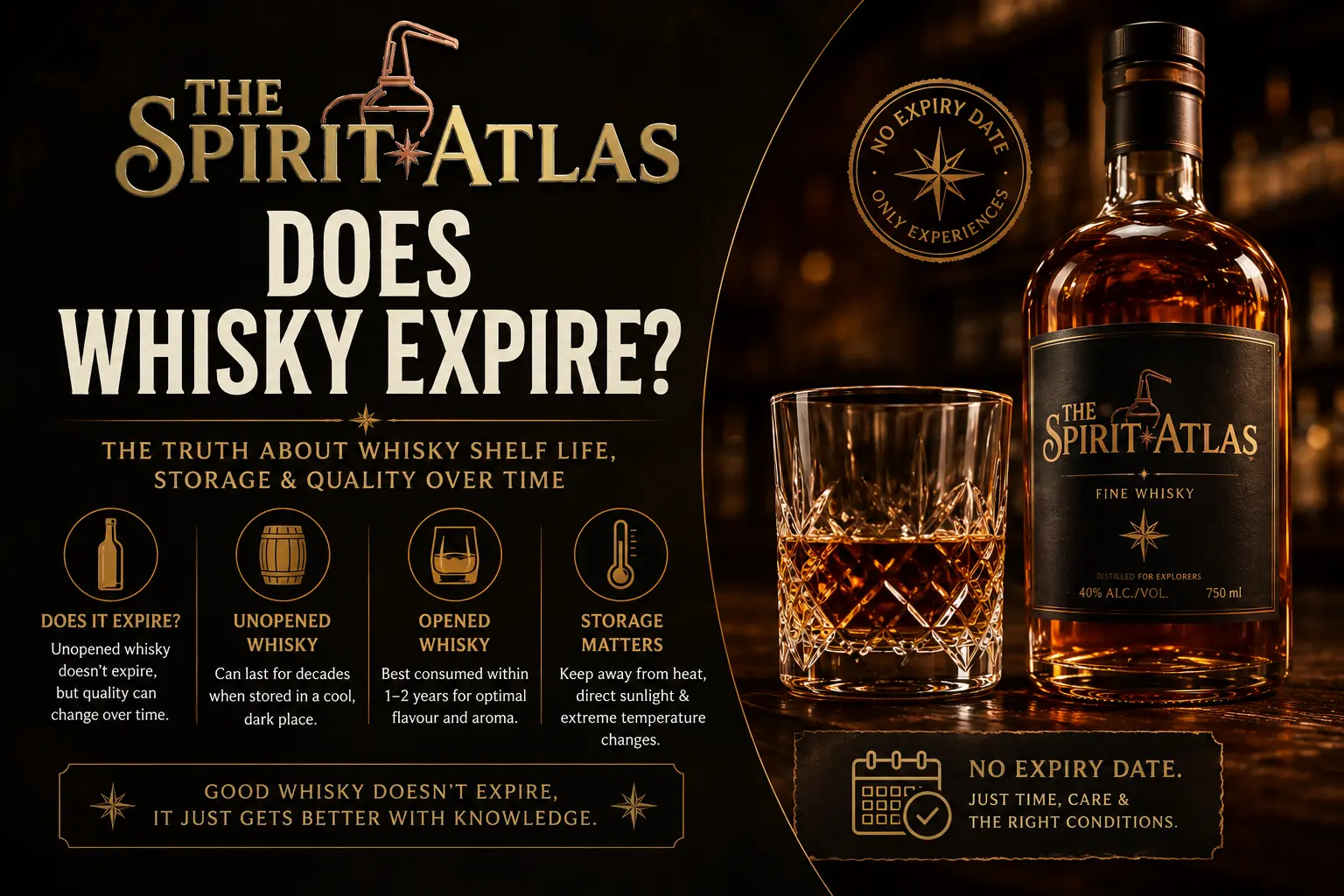
Does Whisky Expire?
Whisky does not expire in the way that milk or bread expires. An unopened bottle of whisky will remain safe to drink for decades, potentially indefinitely, as long as it is stored correctly. There is no expiry date on a bottle of whisky because there is no moment at which the spirit becomes harmful or undrinkable purely due to age.
However, whisky can change, and sometimes those changes are not for the better. An opened bottle left sitting with very little liquid inside can deteriorate in quality over months, particularly if exposed to heat, light, or frequent temperature swings. In India, where summer temperatures can push past 40 degrees Celsius and humidity swings between seasons, proper storage makes a genuine difference to how long your opened bottles stay in good condition.
The distinction between an unopened bottle and an opened one is the key to understanding whisky shelf life.
Written by Shivam Sharma, founder and editor of The Spirit Atlas
How Long Does Unopened Whisky Last?
An unopened bottle of whisky can last indefinitely. The high alcohol content, around 40% to 46% ABV for most expressions, prevents microbial growth. Nothing biological can grow in a whisky bottle. The sealed cap prevents oxidation, which is the main chemical process that degrades spirit quality over time.
Whisky also does not continue to mature in the bottle. Once it is removed from the cask and bottled, the ageing process stops. A 12-year-old Scotch single malt kept unopened for another 20 years does not become a 32-year-old whisky. It remains a 12-year-old whisky, chemically and in terms of flavour profile, as long as the seal is intact. To understand why this is the case, the guide on how whisky is made explains the relationship between cask maturation and flavour development.
This matters for collectors who buy whisky as an investment. A bottle of rare whisky that has been unopened and stored well for 40 years retains its original character. The unopened bottle is the gold standard for preservation.
How Long Does Opened Whisky Last?
Once a bottle of whisky is opened, the clock starts. Oxidation begins the moment air enters the bottle. How quickly this affects quality depends on three factors: how full the bottle is, how it is stored, and the ABV of the whisky.
A whisky bottle that is more than three-quarters full will remain in good condition for one to two years after opening, assuming it is stored properly away from light and heat. The large amount of liquid relative to the air space means oxidation proceeds slowly.
As the bottle gets below half full, the ratio of air to liquid increases and oxidation accelerates. A bottle that is one-quarter full or less may show noticeable flavour changes within three to six months, particularly if kept in warm conditions. In Indian homes that are not air-conditioned and see summer temperatures above 35 degrees, the shelf life of an opened bottle is shorter than the guidance written for European or UK conditions.
Higher ABV whiskies are more resistant to quality changes after opening than lower ABV expressions. Understanding whisky alcohol percentage and how it relates to preservation is useful here. A cask strength expression at 58% will last significantly longer in an opened bottle than a standard 40% expression because the higher alcohol concentration acts as a better preservative.
How to Tell If Whisky Has Gone Bad
Whisky that has deteriorated in quality will show recognisable signs. It is unlikely to be harmful to drink, but the experience will not be what you expected from the bottle.
Smell - Poor oxidised whisky smells flat, slightly vinegary, or overly musty. The fresh fruit and grain aromas that characterise good whisky are replaced by a dull, sometimes acidic note. Trust this signal.
Colour change - Unusual sediment or cloudiness in a room-temperature bottle that was clear before is worth noting. Some whisky naturally shows cloudiness when chilled due to fatty acids, which is harmless. But unexpected sediment in a room-temperature whisky can indicate oxidation.
Taste - Flat, thin, or vinegary flavour where there was once complexity is the clearest sign. Some flavour evolution in an open bottle is normal in the early weeks after opening and can even be positive. Distinctly unpleasant flavour in a previously enjoyable bottle signals oxidation has progressed too far.
Does Whisky Go Bad in Indian Summer Heat?
This is a genuinely important question for Indian drinkers. Extreme heat accelerates the oxidation of opened bottles and can cause flavour and colour changes in sealed bottles over very long periods of exposure.
A sealed bottle exposed to occasional summer heat, even temperatures above 35 degrees for a few weeks, is unlikely to suffer lasting damage. But opened bottles stored in consistently hot conditions, on a kitchen shelf above a gas cooker, in a cupboard that gets afternoon sun, or in a car during summer, will deteriorate faster than one kept in a stable, cool room.
The critical variable is consistency. A bottle that stays at 30 degrees consistently is better off than one that swings between 20 degrees at night (when the AC runs) and 38 degrees during the day. Temperature fluctuation accelerates both oxidation and the expansion and contraction of the cork, which can gradually allow more air into the bottle.
For complete guidance on protecting your bottles in the Indian climate, the how to store whisky guide covers everything from temperature and light to bottle position and how to slow oxidation in opened bottles.
Can You Drink Old Whisky Found in a Cupboard?
Almost certainly yes, if it has been sealed. Check the seal is intact. Give it a careful smell when opened. Taste a small pour before committing to a full glass. If it smells and tastes like whisky, it is whisky.
Old, opened bottles found in a cupboard require more caution. Smell it first. If it smells flat, musty, or distinctly acidic, the quality has likely deteriorated. It will not poison you, but it may not be worth drinking. Whisky is fairly forgiving in this regard because the high alcohol content prevents the kind of dangerous bacterial contamination that affects food and lower-alcohol drinks.
IMFL whisky brands like Royal Stag or economy expressions found as old stock behave the same way as premium bottles in this regard. The quality may have shifted in an opened bottle left in warm conditions, but the spirit is not going to be harmful.
Frequently Asked Questions About Whisky Expiry
Does whisky expire or have an expiry date?
Whisky does not have a legal expiry date and does not expire in the traditional sense. An unopened bottle stored correctly will remain safe and drinkable indefinitely. The high alcohol content prevents microbial spoilage. Opened bottles can deteriorate in quality over time due to oxidation, but they do not become harmful to drink in normal circumstances.
Can whisky go bad after opening?
Yes, whisky can change negatively after opening, though it does not become dangerous. Oxidation gradually changes the flavour of opened whisky. A bottle that is less than one-quarter full and has been open for six months or more in warm Indian conditions may taste noticeably flatter or more acidic than when first opened. This is a quality change, not a safety issue.
How long does an opened bottle of whisky last in India?
A well-stored opened bottle more than half full should remain in good condition for one to two years in a cool, dark location. In Indian summer conditions without air conditioning, shelf life is shorter. A bottle less than one-quarter full stored in warm conditions may show flavour changes within three to four months. Transfer the remaining whisky to a smaller bottle to reduce air space and extend its useful life.
Does whisky age in the bottle?
No. Whisky stops ageing once it is removed from the cask and bottled. The interaction between spirit and wood during cask maturation is what creates the ageing process, and that cannot happen in a sealed glass bottle. A 12-year-old whisky kept in the bottle for another decade is still a 12-year-old whisky, not a 22-year-old one.
Does old whisky taste better?
Not automatically. Very old, unopened bottles from historical distilleries are prized by collectors and can be extraordinary to taste. But a standard bottle of whisky kept on a shelf for 10 extra years does not improve in quality. If anything, a poorly stored opened bottle will deteriorate over time. The quality of whisky is set during cask maturation, not during bottle storage.
What should you do with a whisky bottle that is almost empty?
Two practical options: drink the remaining whisky within a reasonable time, or transfer it to a smaller bottle to reduce the air space. Many whisky enthusiasts keep small glass bottles specifically for consolidating the last quarter of opened bottles. Reducing the air-to-liquid ratio significantly slows down oxidation and extends the life of the remaining whisky.