India Just Became the World's Biggest Rum Obsessed Country, and Nobody Saw It Coming
For as long as anyone can remember, rum has been a Caribbean story. Pirates, beach bars, sugarcane plantations in Jamaica and Barbados, the whole sun-soaked mythology built around islands thousands of kilometres from Indian shores. That story just changed in a way the global spirits industry did not see coming.
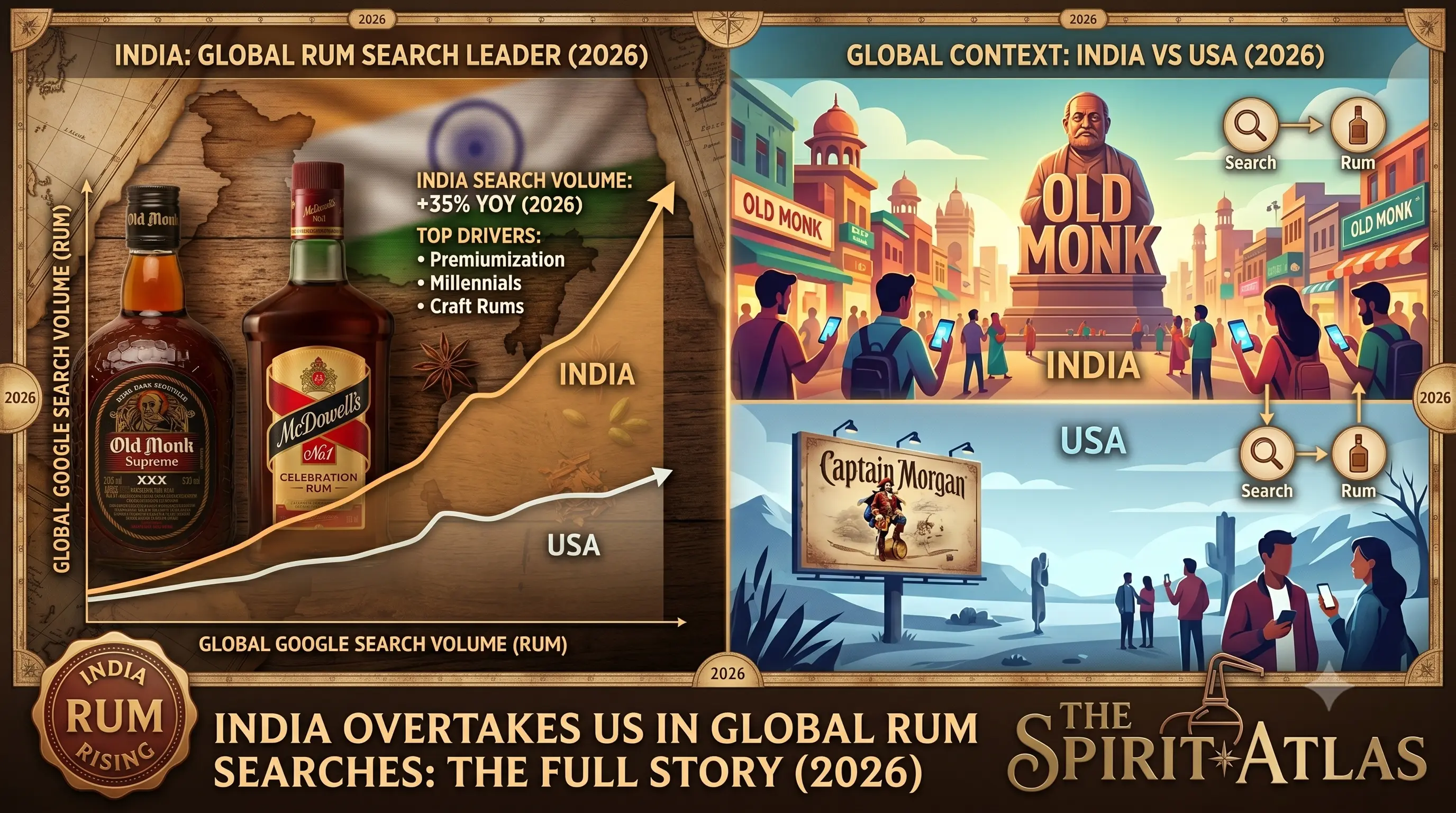
India has overtaken the United States to become the country with the single biggest share of global rum searches in the world, according to new data from experts, one of the largest spirits search and pricing databases globally. Some 36 percent of all rum searches worldwide now originate in India, eclipsing the US for the first time in the platform's history. This is not a small shift. This is India quietly becoming the centre of gravity for global rum interest, and most people, including most people in the global rum industry, have not caught up to what that means yet.
The Numbers Behind India's Rum Takeover
The scale of this shift becomes clear once you look past the headline. With India accounting for 36 percent of global rum searches and the United States making up most of the rest, together the two countries now represent roughly 70 percent of all rum search interest worldwide. That leaves traditional rum strongholds like the United Kingdom, Germany, and the Philippines fighting over just 6 percent of global searches between them. Countries that built their entire spirits identity around rum, the historic colonial trade routes, the tiki bar culture, the centuries of Caribbean rum heritage, are now a rounding error compared to what is happening in India.
What makes this even more striking is that overall global rum search volume has actually been falling. Searches dropped by almost 30 percent between 2023 and 2024 and have continued declining since, albeit more slowly. So India is not simply riding a global rum boom. India's share of a shrinking global interest pool has grown so dramatically that it is now propping up the entire category's search relevance almost single handedly.
This lines up with what the broader numbers already show about India's drinking habits. India's total beverage alcohol volume rose 7 percent in the first half of 2025 alone, making it one of the fastest growing alcohol markets anywhere in the world, and industry forecasts now expect India to become the world's fifth largest alcohol market by 2031, trailing only China, the United States, Brazil, and Mexico.
Six of the World's Ten Most Searched Rums Are Now Indian
Here is the detail that genuinely surprised industry analysts. Out of the global top 10 most searched rums in the world, six are now Indian brands, and four of the top five spots belong to India. McDowell's No.1 Celebration and Old Monk Coffee X.O. Rum both feature prominently on a list that, just a few years ago, would have been dominated entirely by Bacardi, Captain Morgan, and Caribbean heritage brands.
This is not a story about Indians suddenly discovering imported rum either. The opposite is true. Indian consumers are increasingly searching for and choosing domestically produced rum over international brands, which is exactly why homegrown names like Old Monk and McDowell's are climbing global search rankings rather than Bacardi or Havana Club. As one industry analysis put it, Indian rum producers have earned quite the pat on the back for this performance, and the presence of additional entries from neighbouring Nepal and the Seychelles suggests an entire regional rum identity is forming around South Asia and the Indian Ocean, separate from the traditional Caribbean centre of the category.
For a complete look at how Old Monk has built this level of dominance over seven decades, read our Old Monk price and variants guide, which breaks down every expression currently driving search interest worldwide.
Why Is India Suddenly the World's Rum Capital?
A few forces are converging at once to drive this shift, and none of them are temporary.
The first is sheer population scale combined with demographics. India has one of the youngest populations in the world, with a median age of just 29, and approximately 10 to 12 million people reach the legal drinking age in India every single year. That is a continuously renewing wave of new drinkers entering the market at a pace almost no other country can match.
The second is price. Rum remains one of the most affordable spirit categories in India, capturing roughly 12 percent of the overall spirits market and particularly favoured in tier-2 and tier-3 cities where it delivers strong value and wide appeal. Out of the global top 10 most searched rums, the global average price tops out at around 250 dollars for the most premium entry, the Bacardi 151, while the rest sit firmly in everyday, accessible price territory. India's rum culture has never needed to be expensive to be loved, and that accessibility is now translating directly into global search dominance.
The third, and perhaps most important long term, is premiumisation. While the volume leaders remain affordable, premium and craft rum is growing fastest. Products priced above Rs 2,000 per bottle have seen steady sales growth, and the rise of small batch Indian rum brands using local ingredients like jaggery, regional spices, and even sherry cask ageing is creating an entirely new aspirational tier within the category. India's rum story is no longer just about volume. It is becoming a quality story too.
The New Wave of Indian Craft Rum Driving Global Curiosity
Search interest does not grow this fast purely on the back of legacy brands like Old Monk. A genuinely new generation of Indian rum is emerging, and it is this innovation layer that is likely pulling fresh global attention toward the category.
Maka Zai, made in Goa, has become the benchmark for India's craft rum ambitions, built from fresh sugarcane juice alongside molasses in a style closer to agricole rum traditions than the molasses-only rums that dominate the mass market. Daku Rum, sherry-aged and sourced from the Chambal region, has built its identity around the rebellious cultural mythology of the Chambal ravines, available in Gold and Silver variants with warm spice notes that mark a clear departure from standard Indian rum profiles. Sitara, a small batch rum made with jaggery and warm Indian spices, is being positioned specifically for cocktail enthusiasts who want depth and natural sweetness rather than the straightforward sweetness of mainstream IMFL rum.
Ochre Spirits, an artisanal Goa-based brand that also produces Mango Citron Rum and Nutty Berry Rum alongside its gin range, exemplifies where this craft movement is heading. The brand is reportedly in discussions for a Pre-Series A fundraise as it scales distribution, with plans to expand further into agave spirits, whisky, and brandy. This is not a hobbyist trend anymore. Real investment capital is following the craft spirits boom in India, rum very much included.
For the full range of dark rum, white rum, and premium Indian rum brands available right now, our complete rum guide covers everything from Rs 300 everyday bottles to premium craft expressions, with current state-wise pricing.
What This Means If You Are Buying Rum in India Right Now
If you have been drinking the same rum for years out of habit, this is a genuinely good moment to look around. The category is more interesting in India right now than it has been at any point in recent memory, and you do not need a large budget to explore it.
At the everyday end, Old Monk remains the benchmark, a seven year aged dark rum that consistently outperforms its price point and is now, by search volume at least, one of the most searched rums on the planet. McDowell's No.1 Celebration sits alongside it as the other major volume leader, lighter and more mixer friendly. Both are covered in detail in our dark rum category guide.
If you want to explore where the category is heading, craft brands like Maka Zai and the new wave of jaggery and sherry cask expressions represent genuinely original Indian rum making, distinct from both the Caribbean tradition and from India's own legacy IMFL brands. These sit in the Rs 1,500 to Rs 2,500 range typically and are worth trying at least once if you want to understand where Indian rum is actually going, rather than where it has already been.
Either way, the data is now unambiguous. The world is searching for Indian rum more than any other country's rum, and that interest is being earned through both genuine affordability at the bottom of the market and genuine innovation at the top. Whatever happens next in global rum culture, it is very likely going to happen here first.
Frequently Asked Questions
Is India really the biggest rum market in the world now?
India has become the country with the largest share of global rum search interest, accounting for 36 percent of all rum searches worldwide according to Wine-Searcher data, overtaking the United States for the first time. This measures search and consumer interest rather than total sales volume, but it represents a major and unprecedented shift in global rum attention toward India.
Which Indian rum brands are most searched globally?
Six of the world's top 10 most searched rum brands are now Indian, with four of the top five positions belonging to Indian brands. McDowell's No.1 Celebration and Old Monk Coffee X.O. Rum are among the most prominent Indian entries on global search rankings.
Why has rum become so popular in India?
Several factors are driving India's rum popularity: a young population with a median age of 29 and 10 to 12 million people reaching legal drinking age annually, rum's affordability compared to other spirit categories, and a growing wave of premium and craft Indian rum brands creating new interest at the higher end of the market alongside traditional value brands like Old Monk.
Has overall global interest in rum been growing or shrinking?
Global rum search volume has actually been declining, falling by almost 30 percent between 2023 and 2024 and continuing to decline more gradually since. India's growing share of this shrinking global search pool means Indian interest is now effectively sustaining the category's global search relevance.
What are the best new Indian craft rum brands to try?
Maka Zai from Goa is considered the benchmark Indian craft rum, made using fresh sugarcane juice in an agricole style. Daku Rum, sherry-aged and inspired by the Chambal region, and Sitara, a jaggery and spice-based small batch rum, represent the newer wave of Indian craft rum innovation distinct from traditional molasses-based IMFL rum.
Is Old Monk still the most popular rum in India?
Old Monk remains one of the most searched and best-selling rum brands both in India and globally, appearing among the world's most searched rums alongside McDowell's No.1. Despite newer craft brands gaining attention, Old Monk's combination of quality and affordability has kept it as the benchmark Indian rum for nearly seven decades since its 1954 launch.