Why Does Whisky Price Keep Changing in India?
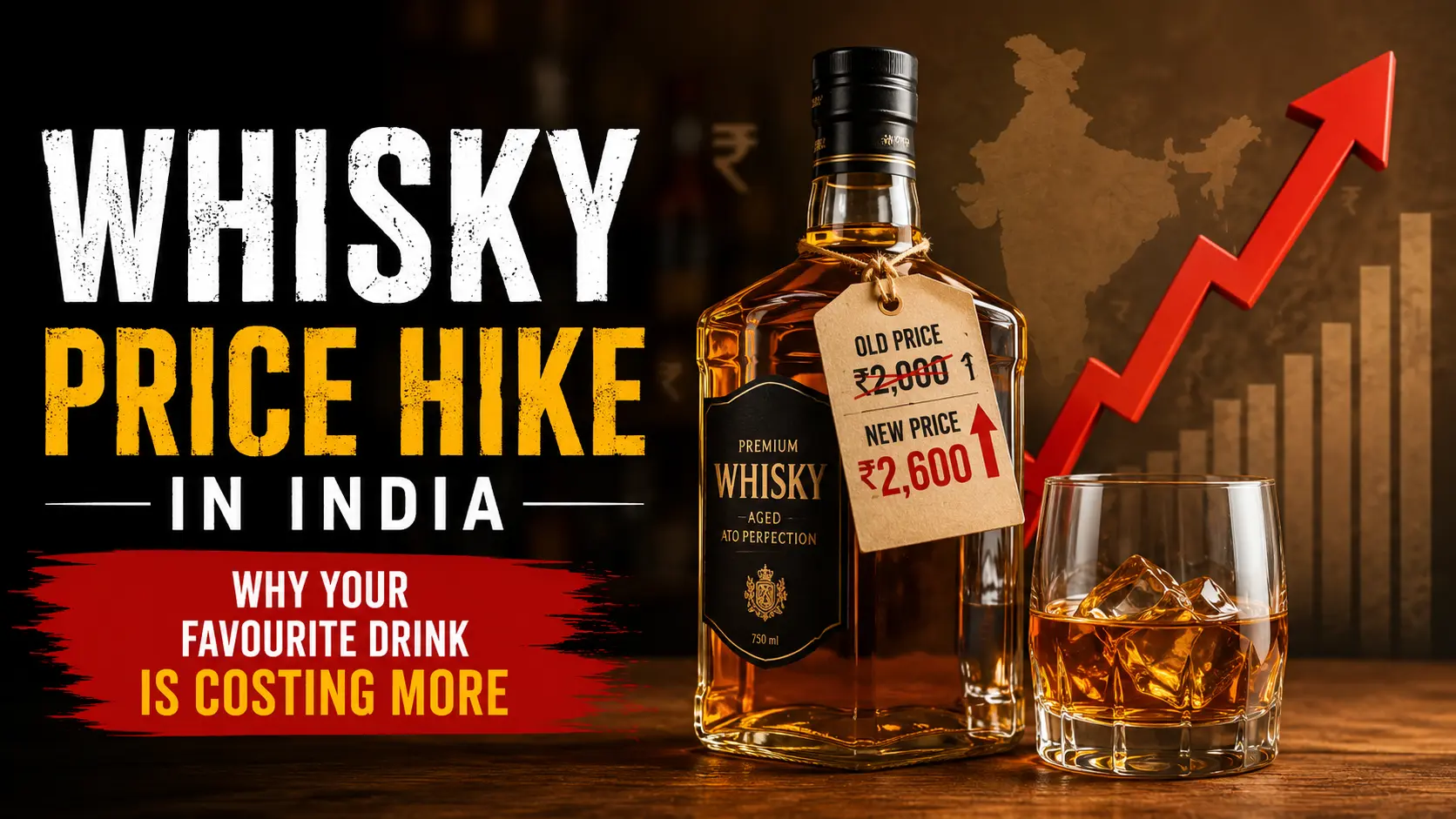
If you have picked up your usual bottle of whisky recently and noticed the price has quietly crept up, you are not imagining things. Across several states in India, whisky prices have gone up in 2026 and in some states, the hike has been significant enough to actually change buying habits. This guide breaks down exactly what is happening, which states are affected, why these whisky price hikes happen at all, and what it means for your wallet and your home bar.
Whether you drink Royal Stag, Blenders Pride, Officer's Choice, or prefer a smoother Indian single malt like Indri, the excise duty changes of 2026 touch almost every price tier.
Before getting into the state-wise numbers, it helps to understand the structure behind liquor pricing in India, because this is genuinely confusing for most people and understanding it will help you make smarter buying decisions.
In India, alcohol is a state subject. That means every state government has the power to set its own excise duty, taxes, and MRP on IMFL (Indian Made Foreign Liquor) independently. The central government does not fix your whisky price. Your state does.
When you buy a 750ml bottle of Royal Stag in Maharashtra for around Rs 880, roughly Rs 450 to Rs 500 of that amount goes directly to the state government in the form of excise duty, education cess, health cess, and VAT, all stacked on top of the basic manufacturing cost. That is more than half the price of the bottle going straight to state revenue. Maharashtra uses what is called a specific duty model, meaning the tax is charged per litre of alcohol content, not as a percentage of the bottle price.
This structure is why the same bottle of whisky costs dramatically different amounts in different states. It is also why a liquor price hike in India is almost always a state excise duty revision in disguise, not a manufacturer decision. So when your state government needs more revenue, because of a budget gap, a welfare scheme, or an infrastructure project, the excise department quietly revises the MRP slabs, and within days your whisky gets more expensive.
State-Wise Whisky Price Hike Updates 2026
Maharashtra: The Biggest Hike of Recent Times
Maharashtra made headlines with one of the sharpest IMFL price revisions in years. The state cabinet approved a hike in excise duty on Indian Made Foreign Liquor from three times the manufacturing cost to 4.5 times, specifically for products with a manufacturing cost of Rs 260 per bulk litre. The duty on country liquor also went up from Rs 180 to Rs 205 per proof litre.
The Maharashtra whisky price hike is expected to generate approximately Rs 14,000 crore in additional annual excise revenue for the state. For consumers, this translated into a price increase of anywhere from 5% to 12% across different whisky brands, with premium and imported Scotch brands seeing sharper increases than budget IMFL.
If you buy Scotch in Maharashtra, Johnnie Walker Red Label, Chivas Regal, or Black Label, you will have felt this most. Indian single malts like Indri also saw some movement upward. More affordable IMFL brands like Royal Stag and Officer's Choice saw smaller absolute increases, but the percentage jump still stings at that price point.
The Maharashtra whisky new price list that came into effect in 2025 and continues into 2026 means a bottle that cost you Rs 820 last year could now sit at Rs 880 or above. If you are buying regularly, that adds up fast across a year.
| Whisky Tier | Approximate Price Increase in Maharashtra |
|---|---|
| Budget IMFL under Rs 500 | 5% to 8% |
| Mid-Premium IMFL Rs 500 to Rs 1500 | 8% to 10% |
| Premium and Indian Single Malt Rs 1500 to Rs 5000 | 10% to 12% |
| Imported Scotch above Rs 3000 | 12% and above |
Andhra Pradesh: Rs 10 Hike Per Bottle From January 2026
Andhra Pradesh implemented a straightforward liquor price hike starting January 2026. The state cabinet approved a Rs 10 increase in the maximum retail price of IMFL and foreign liquor across all bottle sizes. According to the official government order GO MS 22 issued on January 13, 2026, the revised prices came into effect between January 8 and January 12, 2026.
The state government expects this revision to generate approximately Rs 1,391 crore in additional annual revenue, a significant number that tells you exactly why states reach for the excise lever so often.
There was one interesting move alongside the price hike: the Andhra Pradesh government rolled back the Additional Retail Excise Tax (ARET) that had been imposed on bars, reducing the financial burden on bar owners by around Rs 340 crore per year. The government also approved a 1% increase in retailer margins on MRP. So bars and retailers got some relief, but as a retail consumer, you are paying Rs 10 more per bottle from January.
Rs 10 per bottle sounds small on paper, but if you drink two or three bottles a month, that is Rs 240 to Rs 360 more per year coming out of your pocket, just because of one state cabinet decision.
Haryana: Marginal Hike of Rs 5 to Rs 25 Per Bottle
Haryana's approach to the whisky price hike has been more measured. The state approved a slight increase in excise duty in the range of 1% to 1.5% on major IMFL brands, which translates to a price rise of Rs 5 to Rs 25 per bottle depending on the brand tier.
One nuance worth knowing here: because competition among liquor contractors in Haryana is intense, popular brands may not actually see any retail price increase even after the duty revision. Contractors sometimes absorb the duty hike themselves rather than pass it to consumers, to keep their sales volumes up. So in Haryana, the actual impact on what you pay at the counter depends partly on which contractor holds the vend in your area.
Budget 2026: Central-Level Pressure on Prices Nationwide
Beyond individual state actions, Budget 2026 has added central-level pressure on liquor pricing across the country. Changes in TCS (Tax Collected at Source), customs duties, and other indirect taxes related to alcohol at the central level are pushing prices upward, even before state excise is factored in.
Industry experts estimate the price rise from central-level budget changes at Rs 50 to Rs 100 per bottle on average, depending on the type of liquor and the state. Premium and imported brands are seeing sharper increases, especially in metro cities. Cheaper locally made IMFL may see smaller hikes, but the direction of travel is the same: up.
Since state excise decisions are made independently, the final impact varies significantly by state. Some states in the past have hiked by 30% to 50% after a central budget announcement; others have stayed flat. The coming months will clarify this further as state excise departments respond to the central budget signals.
Which Whisky Brands Are Affected Most by the 2026 Price Hike?
Not all whiskies are hit equally by a price hike. Here is a general pattern that holds across most Indian states:
- Budget IMFL under Rs 500: Brands like Officer's Choice, Royal Stag, and McDowell's No.1 see smaller absolute rupee increases, but a 5% to 10% hike still matters to their core buyers who are very price-sensitive.
- Mid-Premium IMFL Rs 500 to Rs 1500: Blenders Pride, 100 Pipers, Imperial Blue, and similar brands in this range see moderate increases. This is the segment most affected by the Maharashtra specific duty model change.
- Premium and Indian Single Malt Rs 1500 to Rs 5000: Indri, Paul John, Amrut, and Rampur saw some of the sharpest percentage increases in high-duty states because their manufacturing cost base puts them in a higher excise slab.
- Imported Scotch above Rs 3000: Chivas Regal, Johnnie Walker, Glenfiddich, and The Macallan carry both customs duty at entry and state excise on top. Any revision in either layer compounds quickly. A bottle of Black and White 750ml that was Rs 3,200 in Andhra Pradesh moved to Rs 3,620 after a recent price revision there.
You can track current prices for all of these on our dedicated spirit pages. Check the IMFL whisky price guide and the Indian Single Malt price guide for updated rates across states.
Why Are States Hiking Liquor Prices So Often?
This is a fair question, and the honest answer is that excise revenue from alcohol is one of the most reliable income streams any Indian state government has. Unlike corporate tax or GST, and alcohol sits completely outside the GST framework, excise on liquor is collected directly and is hard to evade.
For many states, excise revenue from liquor accounts for 15% to 20% of their total own-tax revenue. Maharashtra alone targets tens of thousands of crores from excise annually. When state budgets face deficits, the excise department gets a target to make up the difference.
The math is simple for the state: people keep buying whisky even after a price hike. Demand for IMFL in India is relatively inelastic, meaning it does not fall sharply even when prices go up. India's total beverage alcohol volume rose 7% in the first half of 2025 alone, making it one of the fastest-growing alcohol markets in the world. States know this, and they price accordingly.
What Should You Do as a Buyer in 2026?
A few practical things worth knowing given the current whisky price hike environment in India:
- Buy before state-level revisions, not after. State excise revisions are often announced with very little notice. Sometimes prices change within days of the cabinet decision. If you follow liquor industry news or state budget sessions, you can sometimes stock up ahead of a revision.
- Compare prices across states if you travel. States like Goa and Punjab traditionally have lower excise duty than Maharashtra or Karnataka. The same 750ml bottle can vary by Rs 150 to Rs 300 across state borders. This is completely legal to take advantage of for personal consumption within limits.
- Check the MRP on the bottle. In India, MRP is printed on every bottle and is state-specific. If a retailer is charging above MRP, that is illegal. Compare the price you are being charged against the MRP printed on the label, not against what the bottle costs in another state.
- Consider moving up one tier. With budget IMFL prices increasing, the gap between a Rs 500 bottle and a Rs 800 bottle sometimes narrows enough that the better quality bottle becomes relatively better value. It is worth doing the maths on your regular buy.
The EU-India FTA and What It Could Mean for Imported Scotch Prices
One development worth watching in 2026 is the EU-India Free Trade Agreement. If ratified, the FTA could ease import duties on wine and spirits from France, Italy, Spain, and Ireland. Scotch from Scotland would potentially benefit significantly, as import duties on Scotch entering India currently sit at around 150%.
If those duties come down, imported Scotch could become meaningfully more affordable in India over the next few years, which would put competitive pressure on premium IMFL and Indian single malts. This is still unfolding, but it is the most significant structural change to Indian liquor pricing that could happen in the medium term.
For now, keep an eye on our Scotch whisky price guide and the Royal Stag price page — we update these regularly as state MRP revisions come through.
Frequently Asked Questions
Why is whisky price different in every Indian state?
Because alcohol is a state subject under the Indian Constitution. Every state sets its own excise duty, cess, and maximum retail price independently. This is why the same bottle of whisky can cost Rs 150 to Rs 300 more in Karnataka compared to Goa.
What does IMFL mean and why does it matter for pricing?
IMFL stands for Indian Made Foreign Liquor. It refers to spirits like whisky, rum, gin, vodka, and brandy manufactured in India. Most popular whisky brands including Royal Stag, Blenders Pride, and McDowell's are IMFL. Excise policy for IMFL is set separately from country liquor, which is why a hike on one may not affect the other equally. Learn more on our IMFL whisky guide.
How much did whisky prices increase in Maharashtra in 2026?
Maharashtra increased excise duty on IMFL from three times the manufacturing cost to 4.5 times for products with a manufacturing cost of Rs 260 per bulk litre. In consumer terms, this translated to roughly a 5% to 12% increase across different whisky tiers, with premium brands absorbing sharper hikes.
Did Andhra Pradesh increase liquor prices in 2026?
Yes. Andhra Pradesh implemented a Rs 10 per bottle increase on IMFL and foreign liquor effective January 2026, under government order GO MS 22 dated January 13, 2026. The state expects this to generate approximately Rs 1,391 crore in additional annual revenue.
Will whisky prices go up more in 2026?
Based on current signals including Budget 2026 changes to TCS and customs duties, plus several states revising excise mid-year, prices are generally expected to continue moving upward in most states. Industry estimates put the average increase from central-level budget changes alone at Rs 50 to Rs 100 per bottle. Individual state revisions could add to this further.
Is there any state where whisky prices went down in 2026?
Not significantly. Some individual brand price revisions in certain states result in specific bottles becoming cheaper as part of a broader MRP rationalisation, but the overall direction of liquor pricing across India is upward in this cycle.
Does the whisky price hike affect Indian single malts too?
Yes. Indian single malts like Indri, Paul John, and Amrut are classified as IMFL and subject to the same state excise revisions as budget IMFL. Because they sit in higher price slabs, a percentage-based excise change can mean a larger absolute rupee increase on these bottles. Check our Indian Single Malt price guide for current pricing.
Where can I check the latest whisky MRP for my state?
The best sources are your state excise department's official website, or our price pages here on The Spirit Atlas. Start with the Royal Stag price guide, the Blenders Pride price page, and the full IMFL whisky section, all updated regularly with current state-wise MRP.