Indian Whisky is Having Its Best Year Ever on the World Stage
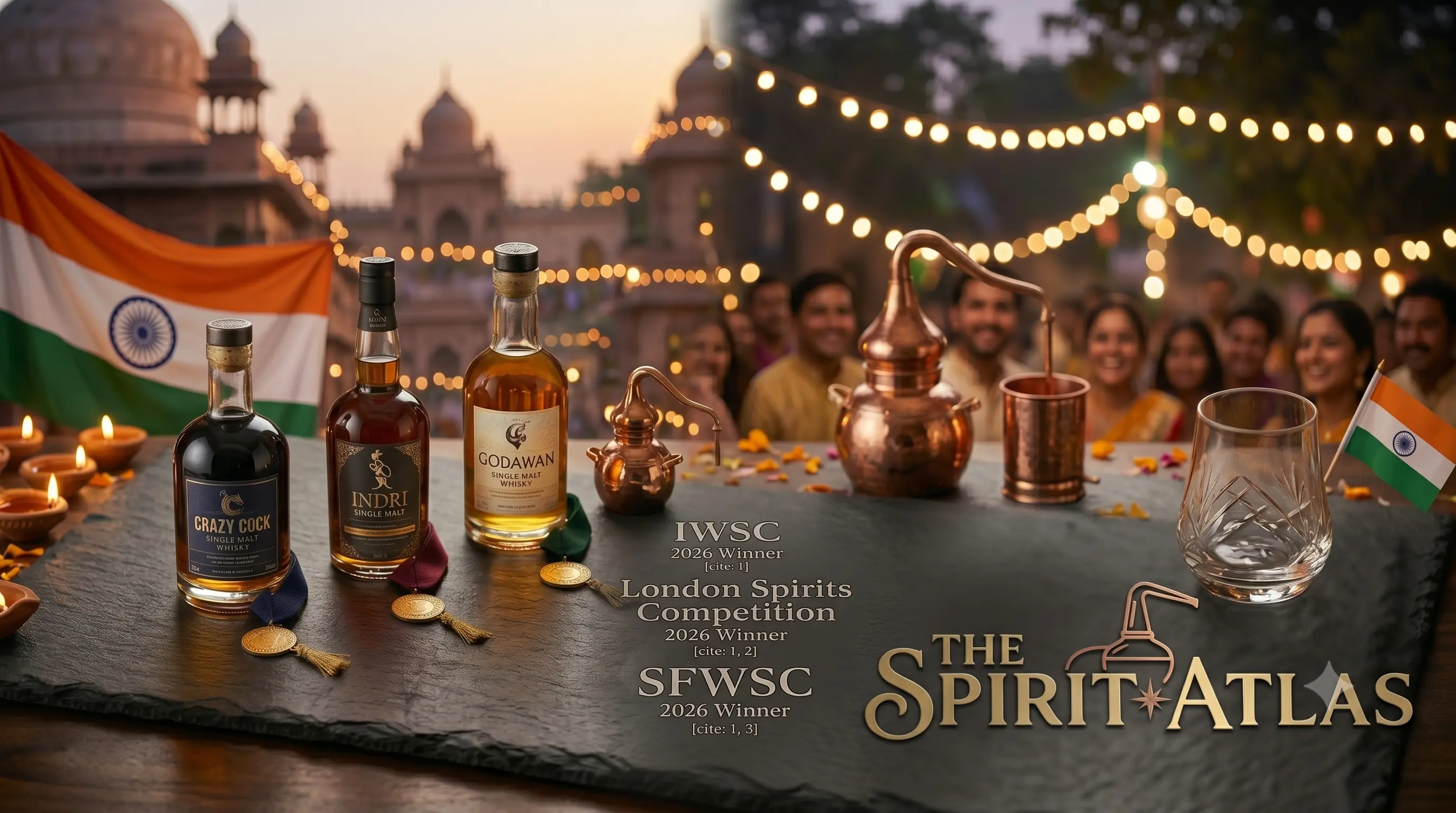
Something remarkable is happening to Indian whisky in 2026. Not quietly, not gradually — but loudly, at the biggest blind-judged competitions in the world, in front of panels that include some of the most respected names in global spirits. Indian single malts are not just participating anymore. They are topping rankings, sweeping medal tables, and doing it with expressions made from ingredients and techniques that feel entirely their own.
If you still think of Indian whisky as a budget category, 2026 has a lot to say to you. This is a complete breakdown of which Indian whiskies won what, which competitions mattered most, what the bottles actually taste like, and what you can buy in India right now without breaking the bank.
Crazy Cock Tops Indian Rankings at IWSC 2026
The International Wine and Spirit Competition (IWSC) has been running blind-judged tastings since 1969. Every entry is assessed purely on quality, balance, complexity, and craftsmanship, with panels drawn from experts across more than 30 countries. Medals range from Bronze at 85 to 89 points up to the rare Gold Outstanding at 98 to 100 points.
At IWSC 2026, the highest-ranked Indian whisky was not Indri, not Rampur, not Amrut. It was Crazy Cock Madhuca III from South Seas Distilleries, which earned a Gold Medal and 95 points. The Madhuca I and Madhuca II expressions each secured Silver Medals with 93 points, placing South Seas Distilleries as the most decorated Indian whisky producer at the entire competition.
What makes the Madhuca range genuinely special is the cask. These are the world's first single malt whiskies finished in Mahua casks. Mahua is one of India's oldest indigenous distillation traditions — a flowering tree whose blooms have been fermented and distilled across central and tribal India for centuries. South Seas Distilleries, described as India's oldest single malt distillers and established in 1969, took that indigenous tradition and applied it as a finishing layer on their single malt. The result is something no Scottish, Irish, or American distillery can replicate. It is distinctly, irreducibly Indian.
Five medals, three expressions, and the top Indian ranking at one of the world's most rigorous competitions. For a brand that most Indian whisky drinkers have never encountered, that is a result worth paying attention to.
Godawan Surpasses 125 Global Awards
While Crazy Cock made headlines at IWSC, Godawan Indian Single Malt from Diageo India quietly crossed a milestone that very few spirits brands anywhere in the world can claim: 125 international awards. This is not a number accumulated over decades. Godawan was launched relatively recently and has accumulated this recognition at a pace that has surprised even industry insiders.
Godawan takes its name from the Great Indian Bustard, one of India's most endangered birds, and the whisky is built around the idea of expressing Rajasthan in a bottle. The barley is Indian, the maturation happens in the intense dry heat of Rajasthan, and the water carries the mineral character of the region. It is matured in American oak ex-bourbon barrels and wine casks and bottled at 42.8% ABV without chill filtration.
At the London Spirits Competition 2026, Godawan received strong recognition. The tasting notes from the LSC judges describe rich caramel and toffee aromas, a balanced palate of oak, orchard fruit, and subtle spice, leading to a long oily finish with toasted nut and subtle liquorice notes. That profile sits comfortably alongside entry-level Scotch single malts that cost significantly more in India after import duties.
What Happened at the London Spirits Competition 2026
The London Spirits Competition judges on three criteria: quality, value, and presentation. That combination makes it particularly useful for consumers because a whisky that wins here has impressed not just on flavour but on whether it delivers for what it costs. The 2026 results for Indian whisky showed real diversity across the medal table.
Indri took the Indian Single Malt Whisky of the Year award. Made by Piccadilly Agro Industries in Haryana, Indri is built on six-row Indian barley, lightly peated and double distilled in copper pot stills, then matured in ex-bourbon and PX sherry casks and bottled at 46% ABV without chill filtration. The LSC judges described the nose as having aromas of slate, marine, and light green peat leading to a fruity spicy palate with a dry full-bodied texture and a long oily finish featuring spiced honey and subtle peat.
Haryana's climate is brutal by Scottish standards. Summers push well beyond what most Scotch warehouses ever experience, and that heat drives faster extraction from the wood. What would take 12 years of gentle ageing in a Scottish dunnage warehouse happens in a fraction of that time in northern India. The spirit itself picks up more intense wood character earlier, which is why even relatively young Indian single malts can feel mature and complex in ways that surprise people expecting Scotch-style development curves.
Woodburns, a blended Indian malt from Fullarton Distilleries in Goa, also picked up recognition at the London Spirits Competition. Goa's coastal climate plays a steady role in its character — the warm temperatures increase interaction between spirit and cask, while humidity shapes how the oak develops. Woodburns combines peated and unpeated Indian malt spirit, matured in charred oak. It is now part of Allied Blenders and Distillers, which has widened its distribution considerably.
For current prices on Indri in India, check our Indri price and review page which is updated regularly with state-wise MRP.
The Surprises at San Francisco World Spirits Competition 2026
The San Francisco World Spirits Competition is one of the largest and most respected blind-tasting competitions in the American spirits world. The 2026 Indian whisky results were short — only three medals — and the names on the list were not the ones most people would have predicted.
No Amrut. No Paul John. No Indri, Rampur, or Godawan. Instead, two of the three medals went to GianChand from DeVANS Modern Breweries in Jammu, and the third went to Kadamba from Imperial Distillers in Goa.
GianChand is produced by DeVANS Modern Breweries, a company founded in Jammu in 1961 by Dewan Gian Chand. For most of its existence, the company was known for bulk malt spirit and Godfather beer. It only began bottling its own branded single malt in 2022. The flagship GianChand single malt is made from 100% Indian six-row barley, distilled in long swan-neck copper pot stills the company designed itself, and matured for around four years in once-used American bourbon barrels. Tasting notes from the San Francisco competition describe brandy snaps, gingerbread, dried apricots, prunes, honeycomb toffee, peat, dry oak, salt, and bitter chocolate.
The peated expression in the range, GianChand Manshaa, medaled at San Francisco after being named International Whisky of the Year 2025 at Meininger's International Spirits Award in Germany, where it took Grand Gold ahead of entries from Scotland, Ireland, the United States, and Germany. For a producer only a few years into bottling its own single malt, that is a remarkable run.
Kadamba's SFWSC medal came from its agave cask finish expression. Made at Imperial Distillers in Goa and named after the Kadamba dynasty that once ruled the region, this whisky is matured in American bourbon barrels and then finished in casks that previously held agave spirit, the base of tequila. The agave finish adds herbaceous, citrus-edged notes over the malt, creating a whisky that works both neat and in cocktails. It is the kind of expression that would not exist anywhere else because the idea of combining Indian single malt maturation with agave cask finishing is a distinctly new and distinctly Indian creative choice.
What Makes Indian Single Malt Different From Scotch
This question comes up constantly and deserves a straight answer. Indian single malt is not Scotch made in a hot country. It is a different category of whisky that happens to share some production methods.
The Indian Malt Whisky Association defines Indian single malts as spirits produced at a single distillery using 100% malted barley, distilled in copper pot stills, and matured for a minimum of three years. That production framework is similar to Scotch. What is completely different is everything else.
The climate is the most obvious factor. India's intense heat, particularly in states like Haryana, Rajasthan, and parts of Tamil Nadu, accelerates maturation dramatically. The angel's share (the whisky lost to evaporation during ageing) in Indian conditions can be three to four times higher per year than in Scotland. Spirit that goes into the cask comes out transformed much faster. This is why you can find Indian single malts with no age statement that taste richer and more developed than 10-year-old Scotch.
The barley matters too. Indian distillers use six-row Indian barley, which has different characteristics from the two-row barley standard in Scotland. The indigenous grain contributes its own flavour compounds. Then there are the cask choices: Indian distillers are experimenting with Mahua casks (as Crazy Cock does), Mizunara Japanese oak (as Doaab does), PX sherry casks (as Indri does), and agave casks (as Kadamba does). None of these combinations existed in Indian whisky a decade ago.
The result is a category that is genuinely diverse, genuinely innovative, and genuinely impossible to replicate outside India. Which is exactly why international competition panels keep noticing it.
For a deeper comparison of Indian single malts versus Scotch on price and taste, read our Indian single malt guide covering all major expressions available in India right now.
Indian Whisky Awards 2026: The Full Picture
Looking across all the major competitions in 2026, a pattern emerges that is more interesting than a simple "Indian whisky is winning" headline.
The established names — Indri, Godawan, Amrut, Paul John — continue to perform strongly and build cumulative award tallies. Godawan crossing 125 awards is a testament to consistent quality across multiple competitions over multiple years. Indri winning Indian Single Malt of the Year at the London Spirits Competition confirms its position as the benchmark mid-premium Indian single malt for international judges.
But the more exciting story is the newer and smaller producers breaking through. Crazy Cock topping IWSC 2026. GianChand winning International Whisky of the Year in Germany. Kadamba medaling at San Francisco. These are distilleries that most Indian consumers, let alone international whisky drinkers, have never heard of. Their success suggests the Indian single malt category is far deeper than its five or six most visible brands, and that the next few years will bring even more names onto international shortlists.
There is one complicating note in the 2026 picture: at the International Spirits Challenge, not a single Indian whisky took home a Gold or Double Gold. Every winner landed at Silver or Bronze, and several of the biggest Indian single malt names were absent from the results entirely. This does not undermine the broader trajectory, but it is a reminder that the category still has variance — different competition formats, different judging panels, and different house styles reward different things. A whisky that impresses judges in San Francisco may not land the same way with a different blind panel in London.
What it means practically for Indian drinkers is that the options available to you right now, in your local liquor store, are better than they have ever been. You can drink whisky made in India, from Indian barley, by Indian distillers, that has been validated by the world's toughest blind-tasting panels. And you can do it without paying the import premium that Scotch carries.
Which Award-Winning Indian Whiskies Can You Buy in India Right Now?
Most of the award-winning bottles mentioned above are available in India, though availability varies by state. Here is a practical summary:
Indri — Widely available across India in major liquor stores and premium retail. Currently the most accessible of the award-winning Indian single malts. See our Indri price guide for state-wise MRP.
Godawan — Distributed by Diageo India, so availability is strong in metros. Rajasthan and Delhi tend to have the most consistent stock. Check our Indian single malt section for current pricing.
Amrut Fusion — One of the original Indian single malts that proved the category could compete internationally, available in most states though sometimes limited in smaller cities.
Paul John — Goa-based, strong availability in South India and metros. The Brilliance and Classic Select Cask expressions are the most widely stocked.
GianChand — Still building national distribution. Currently easiest to find in Delhi and northern Indian markets given the Jammu origin. Worth seeking out given the international recognition it has accumulated in a very short time.
Crazy Cock Madhuca — Limited availability currently. South Seas Distilleries is a smaller producer and the Madhuca range is not yet in wide retail. Worth checking specialty spirits retailers and premium hotel bottle shops in metros.
For a full list of Indian single malt prices across states including Delhi, Mumbai, Goa, Karnataka, and Tamil Nadu, our Indian single malt price guide is the most comprehensive source updated with current MRP.
Frequently Asked Questions
Which Indian whisky won the top ranking at IWSC 2026?
Crazy Cock Madhuca III from South Seas Distilleries won the top Indian whisky ranking at the International Wine and Spirit Competition 2026, earning a Gold Medal with 95 points. The Madhuca I and Madhuca II expressions each earned Silver Medals at 93 points, making South Seas Distilleries the most decorated Indian producer at the competition.
What is Mahua cask whisky and which brand uses it?
Mahua casks are made from the wood associated with the Mahua tree, which has been central to indigenous Indian distillation traditions for centuries. Crazy Cock's Madhuca range from South Seas Distilleries is recognised as the world's first single malt whisky finished in Mahua casks. The finish adds flavour characteristics that are unique to the Indian subcontinent and cannot be replicated elsewhere.
Which Indian whisky won at the London Spirits Competition 2026?
Indri from Piccadilly Agro Industries in Haryana won the Indian Single Malt Whisky of the Year award at the London Spirits Competition 2026. The competition judges on quality, value, and presentation, making it one of the more consumer-relevant international awards.
How many awards has Godawan Indian Single Malt won?
Godawan Indian Single Malt from Diageo India has surpassed 125 international awards as of 2026, making it one of the most decorated Indian spirits brands in competition history.
Which Indian whiskies won at the San Francisco World Spirits Competition 2026?
Only three Indian whiskies medaled at SFWSC 2026. Two came from GianChand by DeVANS Modern Breweries in Jammu, including the peated Manshaa expression. The third medal went to Kadamba's agave cask finish expression from Imperial Distillers in Goa.
Why does Indian single malt taste different from Scotch?
Indian single malt differs from Scotch primarily because of climate, barley, and cask choices. India's intense heat accelerates maturation dramatically, with angel's share (annual evaporation loss) running three to four times higher than in Scotland. Indian distillers use six-row Indian barley rather than the two-row barley standard in Scotland. They also experiment with unique cask types including Mahua, Mizunara Japanese oak, and agave casks, creating flavour profiles that cannot exist in Scotch production.
Where can I buy award-winning Indian single malt in India?
Indri and Godawan are the most widely available award-winning Indian single malts, found in premium liquor stores across major cities. Paul John is widely available in South India and metros. GianChand is currently easier to find in Delhi and northern markets. Crazy Cock's Madhuca range has limited national distribution and is best found in specialty spirits retailers in metros. Check our Indian single malt price guide for current state-wise availability and MRP.